

India’s First Telecom Manufacturing Zone In Gwalior Could Shape The Next Phase Of Make In India Telecom


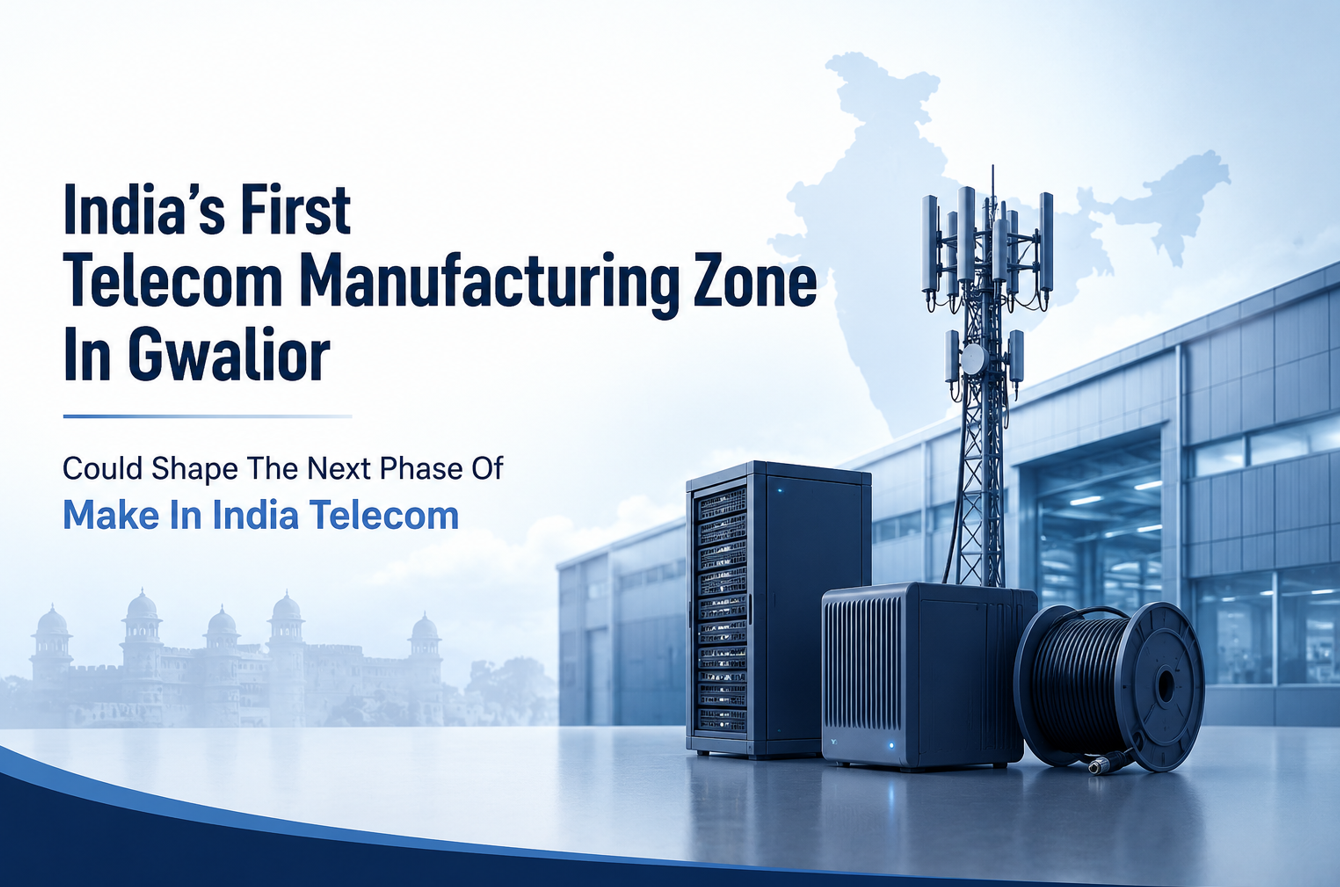
India’s telecom growth is usually seen through mobile towers, 5G networks, cheap internet plans, and smartphones. But the next big shift may come from something less visible and more powerful: manufacturing.
The Department of Telecommunications, under the Ministry of Communications, and the Government of Madhya Pradesh will sign an MoU on 30 July 2026 at Vigyan Bhawan, New Delhi, to establish India’s first Telecom Manufacturing Zone, or TMZ, Phase-I, in Gwalior.
This is not just a state-level industrial project. It is a Centre-State effort to build a stronger domestic telecom manufacturing ecosystem. If the plan is executed well, Gwalior could become an important base for telecom equipment makers, technology companies, MSMEs, and startups working across India’s telecom value chain.
Why this MoU matters
The MoU will create the cooperation framework between the Department of Telecommunications and the Madhya Pradesh government for setting up the TMZ Phase-I in Gwalior.
According to the official PIB release, the signing ceremony will be attended by Union Minister for Communications and Development of North Eastern Region Shri Jyotiraditya M. Scindia, Madhya Pradesh Chief Minister Dr. Mohan Yadav, and Minister of State for Communications and Rural Development Dr. Chandra Sekhar Pemmasani, along with other dignitaries.
The presence of both central and state leadership shows that the project is being treated as a strategic manufacturing push, not just another industrial park.
The bigger aim is linked to Aatmanirbhar Bharat. In simple terms, India wants to reduce dependence on imported telecom products and build more of its own telecom equipment, components, and next-generation solutions inside the country.
What is a Telecom Manufacturing Zone
A Telecom Manufacturing Zone is a focused industrial ecosystem for telecom products and allied technologies.
Instead of companies working separately in different cities, a TMZ can bring manufacturers, suppliers, testing facilities, design teams, MSMEs, startups, and technology partners into one connected zone.
For example, one company may make telecom equipment. Another may supply parts. A startup may work on network software. A testing lab may check product quality. A small manufacturer may support packaging, tools, or components.
When all these players are near each other, the full system becomes faster and more efficient.
This is how strong manufacturing clusters work. They reduce delays, improve coordination, and help companies scale with better support around them.
Why Gwalior could benefit
Gwalior has not traditionally been seen as India’s top telecom manufacturing hub. That space has usually been associated with regions such as Noida, Chennai, Bengaluru, Hyderabad, Pune, and parts of Gujarat.
This gives Gwalior a fresh opportunity.
If the TMZ attracts serious companies and supporting infrastructure, it can help Madhya Pradesh move deeper into high-tech manufacturing. The state’s central location may also help companies serve different regions of India more easily.
For Gwalior, the future effects could be visible in jobs, skill training, logistics, local business growth, and stronger industrial identity.
A large project like this can create direct and indirect employment. Direct jobs may come in manufacturing, assembly, engineering, quality testing, operations, and management. Indirect jobs may come through transport, food services, housing, maintenance, training centres, and small local vendors.
What the TMZ aims to achieve –
The official goal is to create a world-class manufacturing ecosystem for telecom equipment and allied technologies.
That means the project is expected to support investment, innovation, indigenous design, domestic manufacturing, and development of next-generation telecom products and solutions.
This is important because telecom is no longer only about phone calls and internet speed. It now supports digital payments, online education, remote work, smart factories, connected vehicles, healthcare systems, government platforms, defence communication, and emergency services.
A stronger local telecom manufacturing base can make India’s digital backbone more secure and more reliable.
It can also help India move from being a large telecom market to becoming a telecom manufacturing and innovation hub.
Future effects on startups and MSMEs
One of the most interesting parts of this development is looking the benefits of MSMEs and startups.
A telecom manufacturing zone can help smaller companies in a practical way. Many startups have ideas, but struggle with manufacturing support, testing facilities, supply-chain partners, and market access.
If the Gwalior TMZ creates a proper ecosystem, startups may find it easier to build and test telecom products. MSMEs can also become suppliers to larger companies in the zone.
For example, a startup building low-cost rural connectivity devices may need hardware design support, small-batch manufacturing, testing, certification, and field partners. A focused telecom zone can make this journey less painful.
This can also help local entrepreneurs enter areas such as network devices, IoT hardware, optical communication products, smart city systems, and telecom software-linked hardware.
Impact on supply-chain resilience
The COVID years and global trade tensions taught companies one hard lesson: supply chains can break quickly.
Telecom equipment is critical infrastructure. If a country depends too much on imports, delays or restrictions can affect network expansion and upgrades.
The Gwalior TMZ can help India build stronger supply-chain resilience. This means India can become better prepared to handle global disruptions by making more products and components locally.
It does not mean imports will disappear overnight. Telecom manufacturing is complex, and many advanced components still need deep supplier networks. But every strong domestic cluster helps reduce pressure and improves long-term self-reliance.
Role in next-generation telecom
India is already thinking beyond 5G. Future telecom will include 6G research, advanced antennas, private networks, satellite communication, connected machines, and smart infrastructure.
A manufacturing zone can support this future if it also encourages research and design, not only assembly.
The report clearly mentions next-generation telecom products and solutions. That point matters. If India wants to become globally competitive, it must not stop at basic manufacturing. It needs design capability, innovation, testing standards, and intellectual property.
That is where Gwalior’s TMZ can become more than a factory zone. It can become a technology development centre if industry, government, universities, and startups work together.
Competitors and market view
Gwalior’s Telecom Manufacturing Zone will enter a competitive manufacturing landscape.
Within India, regions like Noida, Greater Noida, Tamil Nadu, Karnataka, Telangana, Maharashtra, and Gujarat already have stronger electronics or technology manufacturing ecosystems.
Globally, India competes with China, Vietnam, South Korea, and Taiwan in electronics and telecom manufacturing.
So Gwalior will need more than land. Investors will look for reliable power, fast approvals, skilled workers, transport connectivity, testing labs, policy clarity, and supplier depth.
If Madhya Pradesh can offer these consistently, the TMZ can become a serious long-term project. If not, companies may continue choosing established manufacturing hubs.
Challenges to watch
The project has strong promise, but its success will depend on execution.
- The first challenge is infrastructure. Telecom manufacturing needs stable power, clean facilities, good roads, digital connectivity, and logistics support.
- The second challenge is talent. Workers and engineers will need training in electronics manufacturing, testing, quality control, and equipment handling.
- The third challenge is supplier development. A zone becomes powerful only when enough supporting companies grow around it.
- The fourth challenge is value addition. India should aim not only to assemble products, but also to design, test, and manufacture important components locally.
Conclusion with key takeaways
The MoU between the Department of Telecommunications and the Government of Madhya Pradesh for India’s first Telecom Manufacturing Zone at Gwalior could become an important step in India’s telecom manufacturing journey.
The project is expected to support domestic manufacturing, attract investment, encourage innovation, help startups and MSMEs, create employment opportunities, and strengthen India’s telecom supply chain.
The idea is promising. The real test will be how quickly the framework turns into factories, labs, skilled jobs, and real products.
Key takeaways –
- India’s first Telecom Manufacturing Zone Phase-I is planned at Gwalior, Madhya Pradesh.
- The MoU will be signed on 30 July 2026 at Vigyan Bhawan, New Delhi.
- The project is a joint effort between the Department of Telecommunications and the Government of Madhya Pradesh.
- It aims to support telecom equipment manufacturing, allied technologies, innovation, and indigenous design.
- The zone may benefit manufacturers, technology companies, MSMEs, startups, and the wider telecom value chain.
Facts Input- PIB-Gov
Discover more from Newskart
Subscribe to get the latest posts sent to your email.

Comments are closed.