

India’s First Homegrown Satellite Battery Gets Flight Heritage, And It Is A Big Step For Private Space Tech


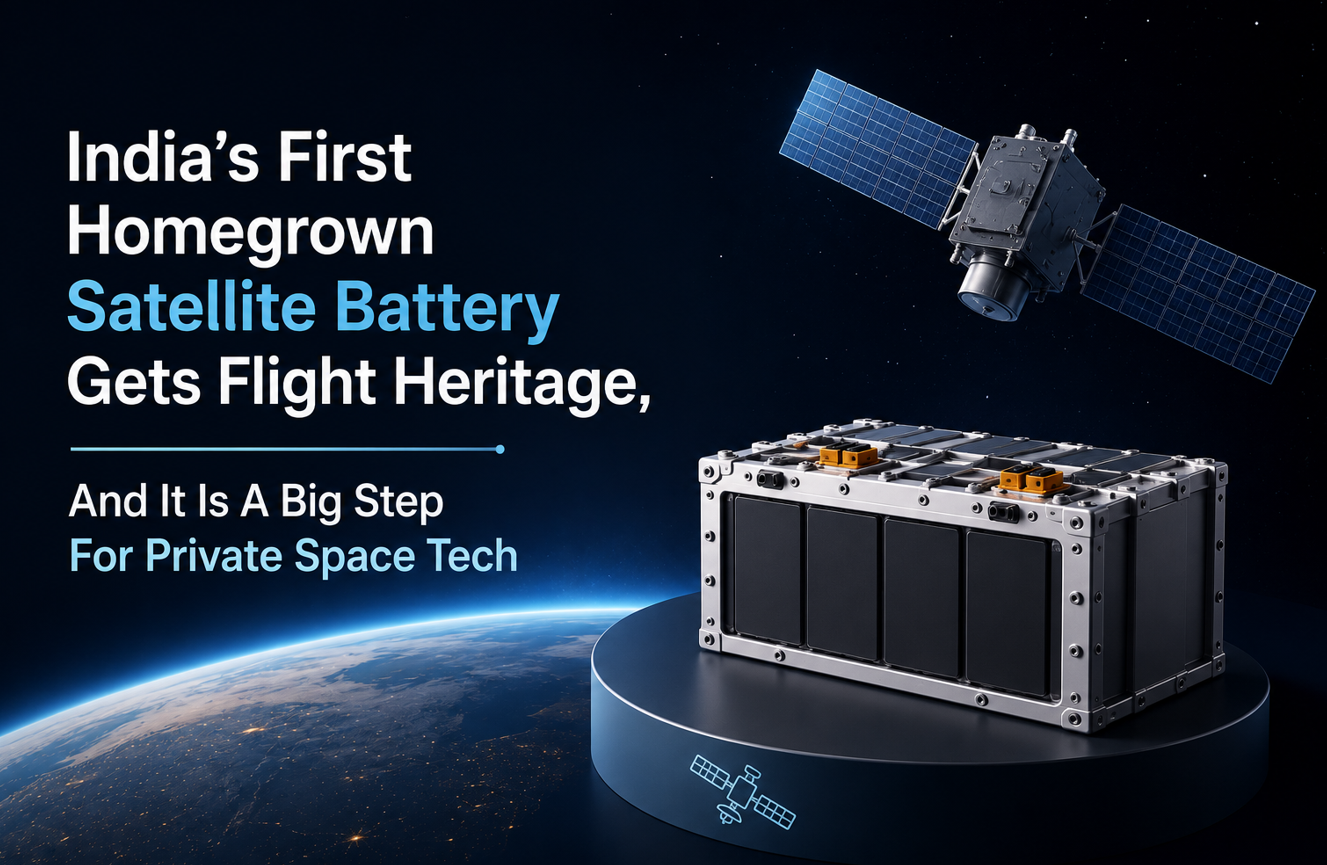
India’s private space sector has just crossed a small but meaningful milestone. Hyderabad-based spacetech startup TakeMe2Space has said its PowerBank-50 satellite battery has earned “flight heritage” after operating in space.
For people outside the space industry, this phrase may sound technical. But in simple words, flight heritage means a space component has actually flown and worked in a real mission. It is no longer just a lab-tested product. It has faced launch vibration, vacuum, radiation, temperature changes, and real orbital conditions.
That is why this update matters. PowerBank-50 is being described as India’s first commercially available, off-the-shelf satellite battery to get this status. For Indian satellite builders, universities, and startups, this can reduce dependence on expensive imported space-grade power systems.
What exactly happened
TakeMe2Space’s PowerBank-50 powered an experimental payload from Cosmoserve Space aboard Skyroot Aerospace’s Vikram-1 “Aagaman” mission.
According to reports, the battery operated at around 450 km altitude in low Earth orbit. It survived the difficult conditions of launch and space, including vibration, shock, vacuum, radiation, and temperature swings.
This successful performance helped the battery move from a ground-qualified product to a space-proven component.
That shift is important. In the satellite industry, buyers usually ask one question very early: has this component flown before? If the answer is yes, trust becomes easier.
About TakeMe2Space
TakeMe2Space is a Hyderabad-based spacetech startup founded by Ronak Kumar Samantray. The company’s own website says it was founded in 2023, while its LinkedIn profile lists 2024 as the founding year. To keep it careful, it is fair to say the company emerged around 2023-24.
The startup is building orbital infrastructure, including satellite subsystems and compute-focused satellites. Its larger idea is to make access to satellites easier for researchers, students, enterprises, and developers.
TakeMe2Space has also spoken about building data centres in space, where satellites can process data in orbit instead of sending everything back to Earth first.
What is PowerBank-50
PowerBank-50 is a compact satellite battery pack made for CubeSats and small satellites.
The company’s product page says the battery stores more than 50 Wh of energy and uses four 18650 lithium-ion cells. It includes a built-in battery management system, cell balancing, health monitoring, and heaters that help the battery survive cold conditions in space.
The battery weighs around 360-380 grams and is designed to fit CubeSat-style satellite systems. TakeMe2Space lists the product at Rs. 1,04,900, positioning it as a lower-cost option compared with many imported satellite battery systems.
A normal reader can think of it like this. A satellite’s solar panels generate power when sunlight is available. But when the satellite goes into Earth’s shadow, it still needs electricity to keep working. The battery stores energy and keeps the satellite alive during those dark periods.
If the power system fails, the mission can fail. That is why satellite batteries are treated as safety-critical components.
What does flight heritage mean
Flight heritage means a product has been used in an actual space mission and has performed as expected.
Ground testing is important, but space is different. A satellite component must survive the violent shaking of launch, then work in vacuum, radiation, and extreme temperatures. Some parts may work perfectly on Earth but fail in orbit.
Flight heritage gives confidence to satellite builders, launch companies, investors, and insurers.
For example, if a university is building a CubeSat, it may hesitate to use a completely new battery. If that battery has already worked in orbit, the risk feels lower. The same applies to startups building commercial satellites. They want parts that are proven, not just promised.
This is why TakeMe2Space’s achievement is more than a product update. It removes a trust barrier.
Why this matters for India
India has strong space capability through ISRO, but the private space ecosystem is still young. Many startups are now building satellites, launch vehicles, sensors, propulsion systems, communication tools, and data platforms.
These companies need reliable local suppliers.
If every critical component has to be imported, missions become costlier and slower. Imported parts can also involve long waiting periods, export restrictions, and currency costs.
A locally available satellite battery with flight heritage can help Indian companies build faster and cheaper. It may also help colleges, research labs, and early-stage startups attempt small satellite missions without depending fully on foreign hardware.
This fits into India’s larger push for self-reliance in space technology.
Why batteries are so important in satellites
A satellite battery is not like a power bank used for phones. It has to work in a much harsher environment.
In low Earth orbit, a satellite may move between sunlight and darkness many times a day. That means the battery keeps charging and discharging repeatedly. It must handle heat, cold, radiation, and long mission life.
It also has to be safe. Battery failure in space can damage other systems or end the mission.
This is why satellite manufacturers care about battery management systems. These systems monitor battery health, control charging, balance cells, and protect the battery from unsafe conditions.
PowerBank-50’s success shows that Indian startups can build such mission-critical subsystems, not only software or ground applications.
Competitors and market view
TakeMe2Space is entering a global market where several established companies already sell satellite power systems.
International names such as Saft, GomSpace, EnduroSat, AAC Clyde Space, and other CubeSat component suppliers have experience in satellite batteries and power subsystems. Many global buyers prefer products that already have strong mission history.
That is why flight heritage is so valuable. It helps a newer Indian supplier stand closer to global competition.
TakeMe2Space’s advantage may be local availability, lower cost, faster procurement, and India-made engineering. But to grow globally, it will still need consistent reliability across more missions, strong documentation, and customer trust.
What this means for startups and universities
This development can be especially useful for small satellite teams.
A university building a student satellite may not have the budget for expensive imported components. A startup building an earth observation or communication satellite may want to test hardware quickly without waiting months for procurement.
An off-the-shelf Indian battery can reduce that friction.
It can also encourage more experimentation. If hardware becomes more accessible, more teams can build, test, fail, improve, and try again. That is how a strong space ecosystem grows.
The road ahead
Flight heritage is a strong first step, but the real journey starts now.
TakeMe2Space will need to prove that PowerBank-50 can perform across different missions, satellite types, and operating conditions. More flights will build deeper trust.
The company may also need to expand its power product line for larger satellites, longer missions, and different power needs.
Still, this is an encouraging signal. Indian spacetech is moving beyond launch announcements and funding stories. It is now producing components that can actually work in orbit.
Conclusion with key takeaways
India’s first homegrown satellite battery earning flight heritage is a meaningful moment for the country’s private space sector. TakeMe2Space’s PowerBank-50 has shown that an Indian-made, commercially available satellite battery can perform in real orbital conditions.
The milestone matters because space hardware buyers value proof. Once a component has flown and worked, it becomes easier for others to trust it.
Key takeaways –
- TakeMe2Space’s PowerBank-50 has earned flight heritage after operating in space.
- It powered Cosmoserve Space’s experimental payload aboard Skyroot Aerospace’s Vikram-1 “Aagaman” mission.
- Flight heritage means a component has been tested in a real space mission, not only in a lab.
- The battery stores more than 50 Wh of energy and is aimed at CubeSats and small satellites.
- The achievement can help Indian startups, universities, and satellite makers access locally available space-proven power hardware.
Facts Input- ET, ToI, TM2Space
Discover more from Newskart
Subscribe to get the latest posts sent to your email.

Comments are closed.