

Indian Startup IPO Tracker This Week: Which Startups Filed for IPO and What It Means for Investors


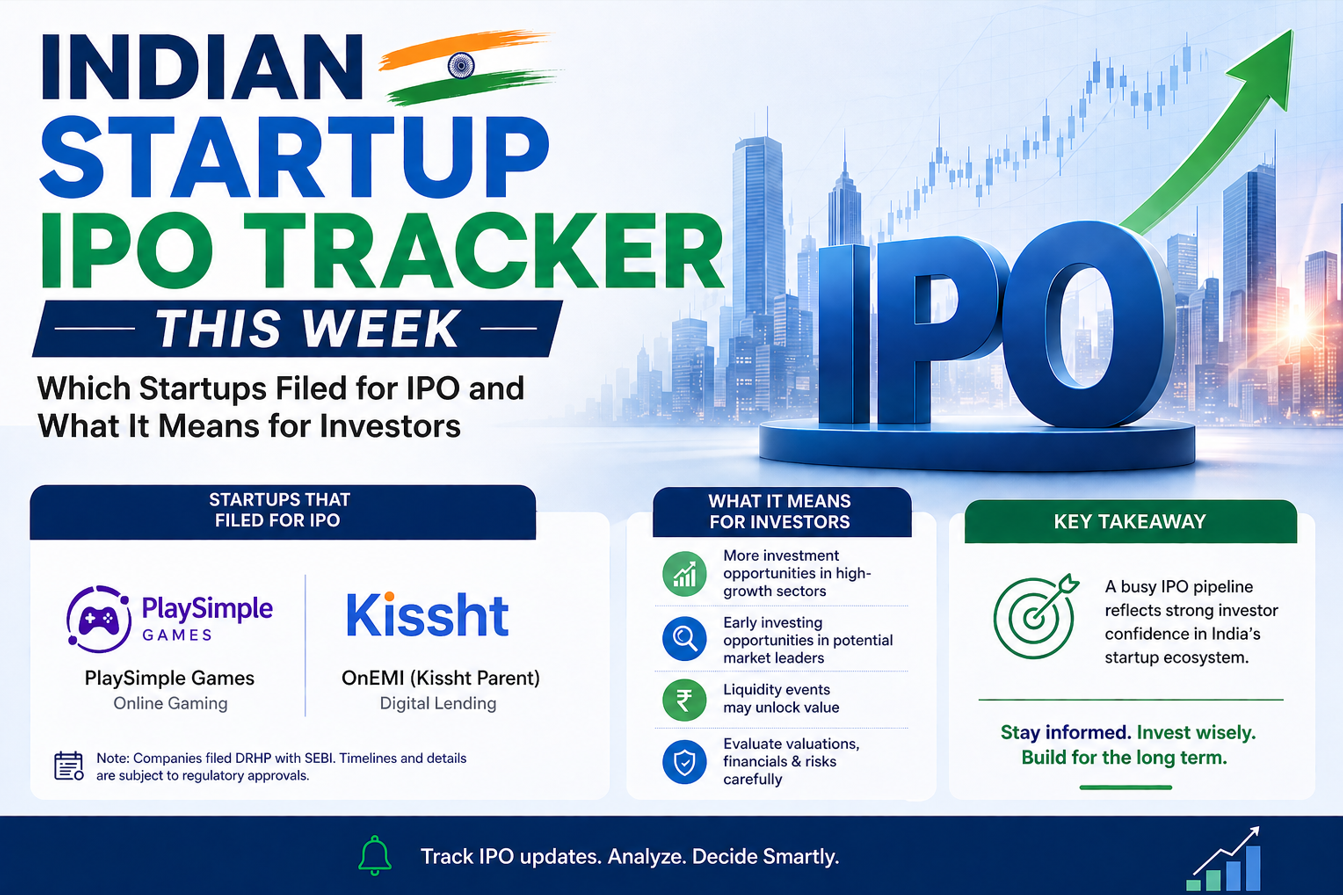
If you follow startup news closely, funding headlines are only half the story. The other half is IPO movement, because that is where private growth narratives are tested in public markets. This week, India’s startup IPO conversation picked up again with fresh filings and pre-launch disclosures that deserve attention.
The biggest shift is not just that companies are “planning” to get listed in the stock market, it is that some are moving from intention to formal documentation with regulators, while others are entering final pre-subscription stages. That difference matters a lot for investors and market watchers, because a DRHP filing and an RHP filing represent different maturity levels in the listing journey.
This article focuses on which startups filed papers for IPO this week in India, and what should we read from those moves?
How to Read This Week’s IPO Activity?
Before we jump into names, here’s a simple way to understand filing stages:
- DRHP (Draft Red Herring Prospectus): early formal filing stage with SEBI; issue details can still evolve.
- RHP (Red Herring Prospectus): later stage document, usually closer to IPO opening with clearer terms.
- IPO opening announcement: subscription window and price band become more concrete for public investors.
So when we say “IPO tracker,” we should track these stages separately. It helps avoid confusion between rumor, draft intent, and near-live issue.
DRHP vs RHP: Full Process and Key Differences
Simple and practical guide for IPO beginners in India
Startup IPO Filing #1 This Week: PlaySimple Games
One of the most visible startup-side IPO updates this week came from PlaySimple Games. As per official communication from MTG (PlaySimple’s parent/promoter), PlaySimple filed its DRHP with SEBI on April 23, 2026. The proposed offer size referenced in coverage is around ₹3,150 crore, and the offer is structured as an Offer for Sale (OFS) by the promoter entity.
Because this is an OFS-heavy structure, the listing narrative is not about fresh capital entering PlaySimple for expansion at this stage. Instead, it is more about promoter-side value realization and public market listing transition. PlaySimple’s move signals continued public-market readiness for gaming/consumer internet categories from India-linked operations. It also keeps the “startup-to-listed” pathway active in a market that has become selective.
PlaySimple Games was founded in 2014 by Siddharth Jain, Siddhant Jain, Suraj Nalin, and Preeti Reddy. Later the Bengaluru-based mobile gaming studio was acquired by MTG in 2021 and later become the full owner.
PlaySimple Games Funding Timeline (So Far)
Early Stage / Seed Support (2014–2016)
What happened: PlaySimple received early backing during its startup growth phase.
Key supporters reported: Chiratae Ventures, Google Launchpad Accelerator.
Why it mattered: Helped build the initial product portfolio and scale core word-game IPs.
Series A Round (Publicly Reported: 2016)
What happened: PlaySimple moved into a formal Series A stage to accelerate growth.
Investors reported: Chiratae Ventures, Elevation Capital, IDG Capital.
Why it mattered: Supported team expansion, technology scale-up, and global user growth.
Strategic Exit / Acquisition by MTG (2021 onward)
What happened: MTG acquired PlaySimple in a two-step transaction and later moved to full ownership.
Deal disclosure: MTG reported total consideration for 100% at approximately SEK 3,090 million (excluding earn-out), with step-one cash consideration around USD 277 million for 77%.
Why it mattered: Marked one of India gaming’s notable strategic outcomes and validated PlaySimple’s scale.
Startup IPO Filing/Progress #2 This Week: OnEMI (Kissht Parent)
The second major startup-related IPO movement this week is from OnEMI Technology Solutions, parent of digital lending platform Kissht. Reports indicate OnEMI filed its RHP around April 25, 2026 and then moved into active IPO schedule communication with subscription set to open on April 30, 2026. The total issue is reported near ₹926 crore, with a mix of fresh issue and OFS components. This is a later-stage step than DRHP. It suggests the issue is close to market participation and valuation discovery.
It offers a live test of public appetite for digital lending businesses, especially in a cycle where investors are balancing growth promise with credit-risk discipline.
OnEMI Technology Solutions, the parent company of the digital lending platform Kissht, was founded in 2015/2016 by Ranvir Singh and Krishnan Vishwanathan in Mumbai.
OnEMI (Kissht Parent) – Funding So Far
Only publicly reported funding milestones
Series C Funding – USD 30 Million
Date reported: Sep 2018
Led by: Vertex Ventures SE Asia & India, Sistema Asia Fund
Also participated: Fosun RZ Capital, Ventureast, Endiya Partners
Use focus: merchant expansion, category growth, and analytics capability
Growth Round – USD 2 Million
Date reported: Feb 2025
Investors: Endiya Partners, Ventureast
Context: bridge/growth capital ahead of later public market transition
Pre-IPO Founder Infusion – ₹40 Crore
Date reported: Apr 2026
By: Founders Ranvir Singh and Krishnan Vishwanathan
Nature: internal promoter capital infusion before IPO opening
OnEMI (Kissht Parent) – Funding & IPO Timeline
Institutional-Backed Growth Phase (Pre-IPO)
What happened: OnEMI scaled with backing from institutional and financial investors.
Key investors reported: Vertex Holdings (Temasek-linked), Ventureast Proactive Fund, Ammar Sdn Bhd, and others.
Why it mattered: Helped build Kissht’s lending and distribution platform ahead of public-market transition.
DRHP Stage (2025)
What happened: OnEMI filed DRHP with SEBI in August 2025 for IPO plans.
Initial structure reported: Around ₹1,000 crore fresh issue proposal at draft stage.
Why it mattered: Marked formal entry into India’s startup-to-public-market pipeline.
RHP + Final IPO Structure (April 2026)
What happened: RHP filed (Apr 25, 2026) and IPO launch window announced.
Issue size reported: ₹925.92 crore (Fresh Issue ₹850 crore + OFS ₹75.92 crore).
Price band reported: ₹162–₹171 per share.
OFS selling shareholders reported: Included Vertex, Ventureast, Ammar Sdn Bhd and others.
What This Capital Journey Signals
OnEMI moved from private institutional backing to public market readiness in a structured manner. Fresh issue component supports growth capital, while OFS enables partial investor liquidity. For readers: this is a classic late-stage fintech transition from venture-backed scaling to public valuation discovery.
Final Takeaway
This week’s Indian startup IPO tracker has two clear headline names, PlaySimple Games with a DRHP filing stage milestone and OnEMI (Kissht parent) with an RHP-stage and near-live IPO schedule movement. Together, they show that startup IPO momentum in India is real, and disciplined. The market is open, yet highly selective. For founders, this means stronger preparation is mandatory. For investors, this means better opportunities exist, but only with sharper due diligence.
Discover more from Newskart
Subscribe to get the latest posts sent to your email.

[…] clearest startup IPO development in this window was Kissht (OnEMI Technology Solutions). The issue had already opened on April 30, but from May 1 onward it remained one of the most […]