

India May Incentivize Long-Duration Energy Storage-What It Means for Power, Prices, and Reliability


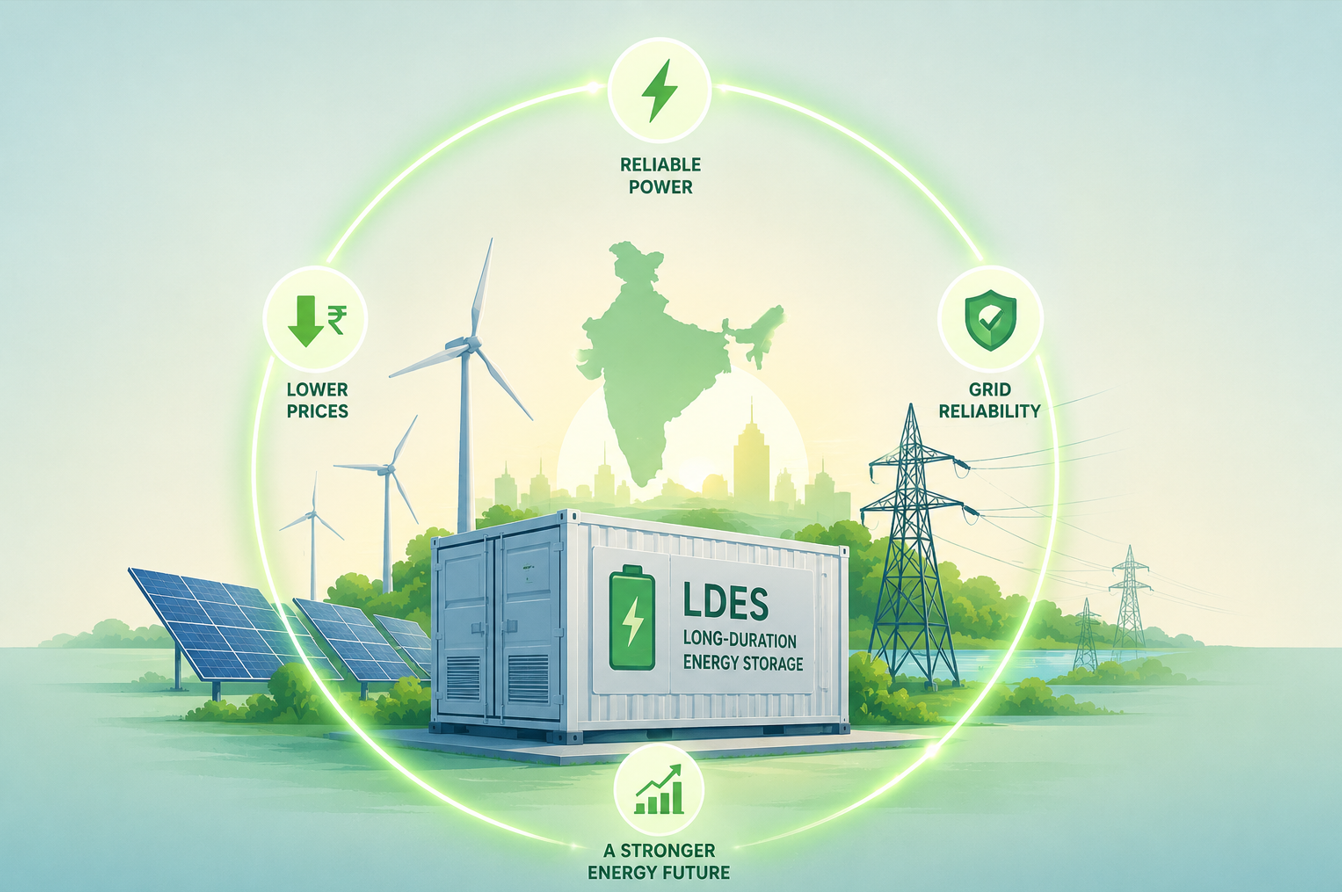
India’s clean energy transition is moving fast, but one problem is becoming impossible to ignore which is solar and wind do not generate power evenly through the day. Solar peaks in daylight, wind can vary by season, and demand often spikes in the evening.
That is why long-duration energy storage (LDES) is now entering policy conversations in a bigger way. Recent reporting indicates the government is considering financial support for LDES, including options like viability gap funding and interest support.
If this becomes a formal policy, it could be one of the most important power-sector changes in the next few years. Let’s unpack what this means in simple language.
What Is LDES, and Why Is It Different?
Most people know batteries as backup tools that run for short periods. LDES is broader. It refers to storage systems that can supply electricity for many hours, and in some cases much longer than typical short-duration batteries. In practical terms, LDES helps shift clean electricity from when it is generated to when it is needed most. So instead of wasting extra solar power at noon, the grid can store it and use it at 8 PM when homes, shops, and offices demand more power.
This is important for three reasons-
- Better grid reliability during peak demand
- Lower renewable curtailment (less wasted green power)
- Reduced dependence on expensive peaking generation
What the Government Is Planning
As of May 2026, the Centre is working on a policy and financial support framework for LDES. The tools under discussion reportedly include Viability Gap Funding (VGF) to make projects financially workable, Interest subvention to reduce borrowing burden and Broader policy support to speed commercial deployment.
At the same time, India has already been expanding its broader storage push through existing frameworks and planning targets. The Ministry of Power’s national framework for energy storage and subsequent policy signals show storage is now treated as core infrastructure, not optional add-on capacity.
So this LDES incentive direction looks like a next step in that larger strategy.
Why This Matters for India’s Power Future
1) Stronger renewable integration
India is adding large renewable capacity. Without enough storage, evening demand can still force higher fossil generation. LDES can close that gap by moving clean power across time.
2) More reliable electricity supply
For consumers, reliability is more important than policy language. LDES can improve stability during demand surges and reduce stress on the system.
3) Better long-term cost economics
Storage projects need high upfront investment, which is why incentives matter. But once scaled correctly, storage can reduce expensive balancing costs and improve system efficiency over time.
4) New industrial opportunity
Incentives can help build a domestic ecosystem across project development, engineering, software controls, and storage technology manufacturing.
Infrastructure for long-duration energy storage (LDES)
Infrastructure needed for long-duration energy storage (LDES) is as follows which helps to store electricity for many hours (or longer) and supply it later when demand is high. In short you can refer below points which are needed for LDES-
- Storage assets: This includes pumped hydro, flow batteries, compressed-air storage, etc.
- Grid connections: This includes substations, transmission links, and interconnection points for the transfer of electricity/power.
- Power electronics: Such as inverters, transformers, control equipment etc.
- Land and civil works: This means sites, water systems (for pumped hydro), construction etc.
- Software and control systems: S/w for forecasting, dispatch, safety, remote monitoring and other control systems.
- Policy and market setup: Such as contracts, tariffs, incentives, and regulations that make projects financially viable.
In simple terms, it is not just the battery/tank/plant itself, but the entire ecosystem that lets stored power reliably reach homes and businesses when needed.
Conclusion- A Timely Move With High Potential
India planning incentives for long-duration energy storage is a strong and timely signal. As renewable capacity grows, storage is no longer optional for grid reliability and cost balance. If policy support is designed well and executed consistently, LDES can help India deliver cleaner electricity with better reliability, especially during peak demand windows. It can also open new industrial growth opportunities in energy technology and infrastructure. LDES is not just about storing electricity. It is about making India’s entire clean energy transition more dependable and scalable.
Facts Input- NewsBytes, PIB release, Ministry of Power, CEA National Electricity Plan
Discover more from Newskart
Subscribe to get the latest posts sent to your email.

Comments are closed.