


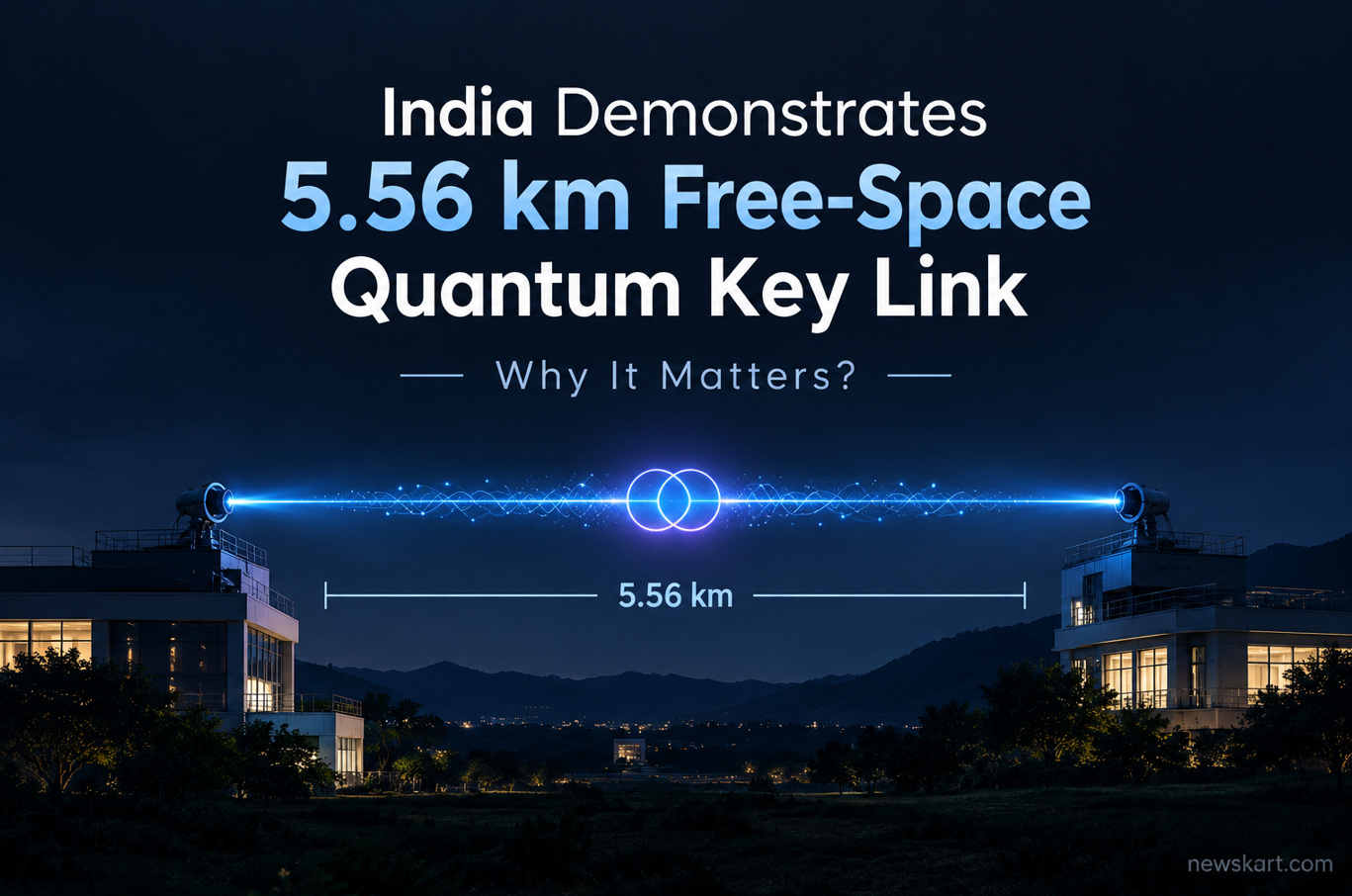
India has demonstrated its first free-space Quantum Key Distribution link over a distance of 5.56 km. The field trial was carried out by deep-tech company QNu Labs in partnership with BISAG-N and IIT Gandhinagar.
The test is important because it shows that secret encryption keys can be shared through open air using quantum technology, without relying on a physical fibre-optic cable between two locations.
The demonstration took place during the night of September 27 and 28, 2026, between BISAG-N and IIT Gandhinagar. The achievement was announced by the Ministry of Electronics and Information Technology on October 3 as per PIB report.
What is a quantum key link?
To understand the achievement, it helps to first understand encryption.
When a person sends sensitive information online, encryption converts the message into a protected form. The receiver uses a secret digital key to unlock it. In traditional systems, security depends mainly on complex mathematical calculations.
Quantum Key Distribution, or QKD, uses the behaviour of tiny particles of light to create and share that key. If someone tries to intercept or measure the quantum signals, the signals change. The sender and receiver can then detect that an outsider may have tried to interfere.
A simple example is a sealed envelope that changes visibly when someone tries to open it. QKD does not stop every possible cyberattack, but it can help the users identify interference while the encryption key is being created.
How the 5.56 km demonstration worked
QNu Labs used its Armos QKD device along with a Pointing, Acquisition and Tracking system. This system keeps the optical equipment accurately aligned between the two locations.
The link achieved a Quantum Bit Error Rate below 5%. This is a measure of errors in the quantum signals, and a lower number generally indicates a more stable connection.
The trial generated secure keys at a rate of around 230 to 260 bits per second. These keys were then used with BISAG-N’s Vedic Kavach platform, which combines post-quantum cryptography with quantum random-number generation. Test messages were encrypted and decrypted successfully from end to end.
It is important to note that this was a ground-based field trial, not a satellite communication mission or a full commercial network as per ToI.
Benefits for India
The technology could support secure communication for defence forces, government departments, financial institutions, research organizations and critical infrastructure operators.
Free-space links are useful where laying fibre cables is difficult. They could connect buildings across large campuses, secure remote facilities or eventually link ground stations with satellites.
The demonstration is also important for India’s future satellite-based quantum communication plans. QNu Labs co-founder and CEO Sunil Gupta said the trial could support longer-distance quantum-secure networks and satellite communication.
ISRO has previously demonstrated free-space quantum communication over 300 metres, while DRDO and IIT Delhi have also conducted longer free-space quantum security experiments. The new 5.56 km demonstration extends India’s experience at a larger field scale.
Challenges ahead
Quantum communication still faces practical difficulties. Clouds, fog, dust, sunlight and atmospheric movement can affect optical signals. The equipment also needs accurate alignment and clear line of sight.
QKD is not a replacement for every cybersecurity tool. It works alongside encryption software, secure networks, authentication systems and post-quantum cryptography. Building a nationwide or satellite-based network will require more testing, higher key-generation rates and reliable operation in different weather conditions.
Conclusion with key takeaways
India’s 5.56 km free-space QKD demonstration is an important research and engineering milestone. It shows that quantum-secure communication can work beyond a laboratory environment and may support future defence, government and satellite networks.
Key takeaways-
- The link covered 5.56 km through open air.
- QNu Labs, BISAG-N and IIT Gandhinagar conducted the trial.
- The system generated secure keys at 230 to 260 bits per second.
- The quantum bit error rate remained below 5%.
- The technology can support secure ground and satellite communication.
- More testing is required before large-scale commercial deployment.
Discover more from Newskart
Subscribe to get the latest posts sent to your email.
