


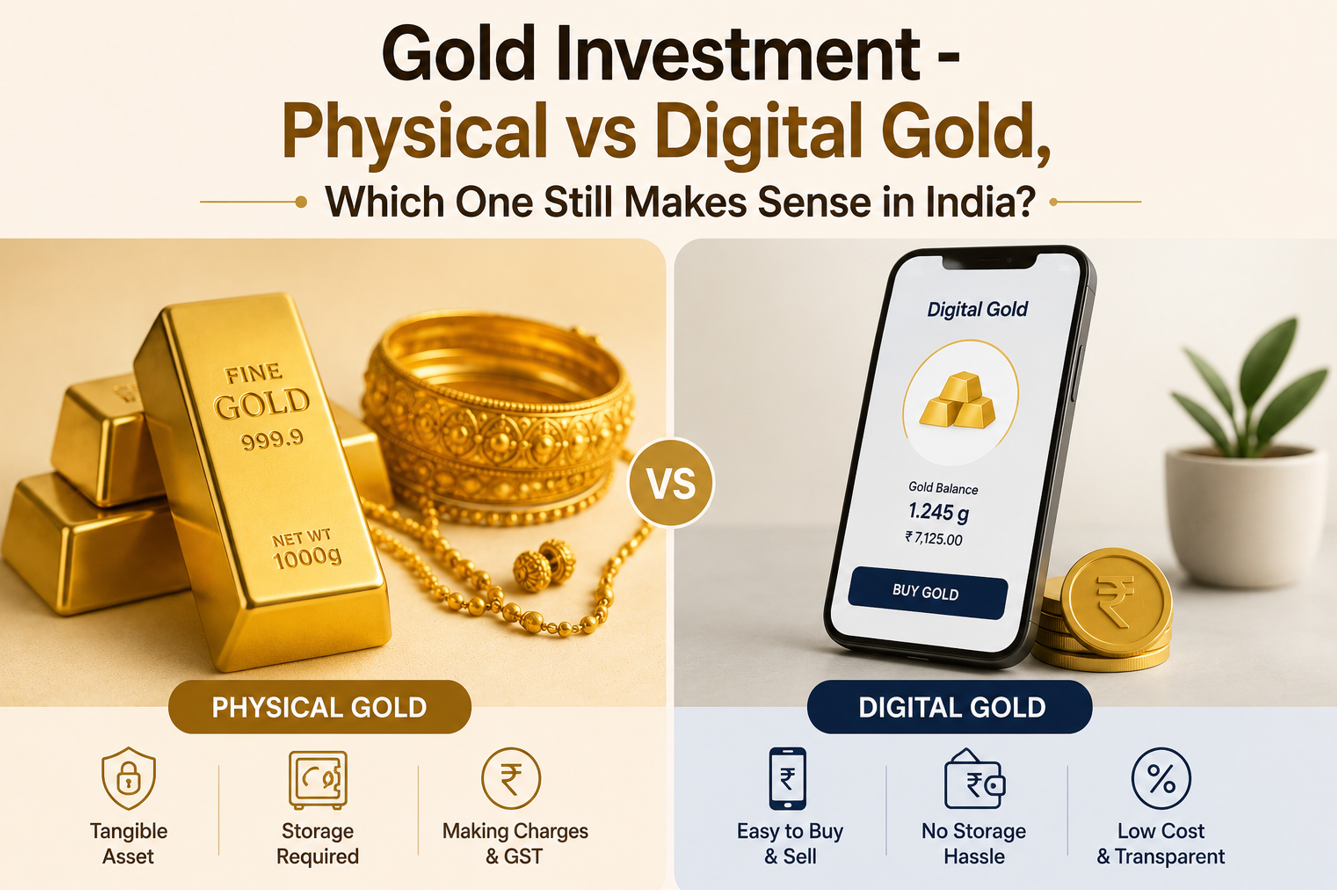
Gold still has a special place in Indian homes. People buy it for weddings, festivals, gifts, emergency savings and long-term wealth protection. Even when stock markets rise and new investment apps appear, gold does not lose its emotional value.
But the way people buy gold has changed. Earlier, most families bought jewellery, coins or bars from a jeweller. Now, many apps offer digital gold where users can buy small amounts online, sometimes for as little as Rs. 10.
This brings up an important question – is gold investment still relevant, and if yes, should you choose physical gold or digital gold?
What physical gold means
Physical gold is the gold you can hold in your hand. It includes jewellery, coins and bars.
Jewellery is the most common form in India, but it is not always the best investment. The reason is simple. When you buy jewellery, you also pay making charges, wastage, GST and sometimes design premium. When you sell it, you may not recover all these costs.
Coins and bars are better than jewellery for investment because they usually have lower making charges. Still, you need to store them safely and check purity before buying.
If you buy physical gold, always choose BIS-hallmarked gold from a trusted jeweller. BIS hallmarking helps confirm purity and reduces the risk of being sold lower-quality gold.
What digital gold means
Digital gold lets you buy gold online through an authorized app or platform. The seller claims that your purchase is backed by real gold stored in a vault.
The biggest attraction is convenience. You can buy small amounts, track value on your phone and sell quickly on the platform. This works well for people who want to slowly build gold exposure without visiting a jeweller.
For example, a beginner may not have Rs. 50,000 to buy a gold coin. But they may put Rs. 500 or Rs. 1,000 every month into digital gold.
The problem is regulation. Digital gold is not treated like a SEBI-regulated security. This means investor protection is weaker compared with regulated products like gold ETFs.
Why gold is still relevant
Gold is still relevant, but it should not be your only investment.
Gold usually works as a safety asset. When markets are uncertain, inflation is high, currencies are weak or global risks rise, many investors move toward gold. It can help balance a portfolio that already has stocks, mutual funds, fixed deposits or real estate.
But gold does not create income like a business. It does not pay rent like property or dividends like some stocks. Its return mostly depends on price movement.
For most people, gold can be a useful part of savings, but not the full plan. A small allocation may help during uncertain times.
Physical gold vs digital gold
Physical gold is better when you want jewellery for personal use, family functions or gifts. It also gives comfort to people who trust something they can physically hold.
But as an investment, physical gold has costs. Making charges, purity risk, storage risk and resale deductions can reduce returns.
Digital gold is easier to buy and sell. It is useful for small purchases and short-term convenience. But it has platform risk, storage trust issues and weaker regulatory protection.
If your goal is serious long-term investment, digital gold should be used carefully. It may look simple, but convenience does not automatically make it safer.
Which is better for investment
If the comparison is only between physical gold and digital gold, the answer depends on your purpose.
For jewellery, family use and emotional value, physical gold is better.
For small online purchases and easy buying, digital gold is more convenient.
For long-term investment, neither physical jewellery nor unregulated digital gold is the best option for most people. Regulated options like gold ETFs or Sovereign Gold Bonds, when available, are usually cleaner choices.
Gold ETFs are traded on stock exchanges and are regulated. They do not require storage at home. Sovereign Gold Bonds are issued by RBI on behalf of the Government of India and also offer fixed interest, though liquidity and availability depend on issue terms and market conditions.
Risks of physical gold
- The first risk is purity. If you buy without checking hallmarking, you may pay for 22K gold but receive lower purity.
- The second risk is cost. Jewellery can have high making charges, and these charges are usually not recovered when selling.
- The third risk is storage. Keeping gold at home can create theft risk. Bank lockers add another cost.
- The fourth risk is resale. Different jewellers may offer different buyback values. Some may deduct melting charges or refuse jewellery bought elsewhere.
Risks of digital gold
- The biggest risk is regulation. SEBI has warned that digital gold products sold on online platforms are not under its regulatory protection.
- The second risk is platform dependence. Your gold is linked to the platform’s records and vaulting arrangement. If the platform faces issues, the process may become difficult.
- The third risk is pricing. Buy and sell prices may have a spread, which means you may lose some value immediately when you purchase and sell.
- The fourth risk is delivery charges. If you convert digital gold into physical gold, extra charges may apply.
What should beginners do
Beginners should first decide why they are buying gold.
- If it is for a wedding or family use, buy physical gold from a trusted BIS-registered jeweller and check hallmark details.
- If it is for investment, compare gold ETFs, SGBs and physical coins before choosing digital gold.
- If it is for small savings, digital gold can be used in limited amounts, but avoid keeping large sums there for years without understanding the platform risk.
A simple rule is this – buy jewellery for use, not pure returns. Buy regulated gold products for investment. Use digital gold only if you understand its limits.
Conclusion with key takeaways
Gold investment is still relevant in India, but the best form depends on the buyer’s goal. Physical gold is useful for cultural, family and personal needs. Digital gold is easy and flexible, but it comes with regulatory and platform risks.
For serious investment, regulated options like gold ETFs and SGBs are usually better than both jewellery and unregulated digital gold.
Key takeaways
- Gold is still useful as a portfolio safety asset.
- Physical gold is better for jewellery, gifts and family use.
- Digital gold is convenient, but not fully regulated like ETFs.
- Jewellery is usually not the best investment because of making charges and resale deductions.
- Gold ETFs and SGBs are cleaner options for long-term investors.
- Always check purity, costs, taxes, liquidity and platform safety before buying.
Disclaimer –
This article is for general information only and should not be treated as financial advice. Gold prices, taxes, charges and rules can change over time. Please speak with a qualified financial advisor before making any investment decision.
Discover more from Newskart
Subscribe to get the latest posts sent to your email.

Comments are closed.