

E-commerce and D2C Startups in India: Funding Trends and Can They Really Compete with Quick Commerce?


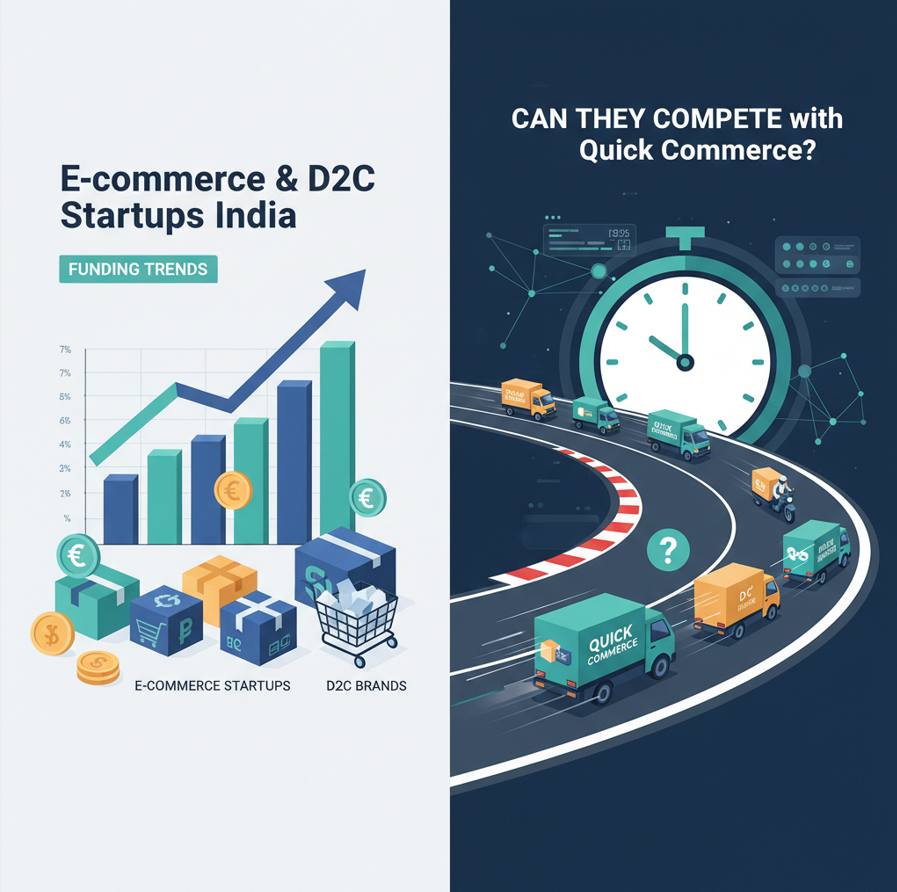
India’s digital retail market is no longer a one-lane road. A few years ago, most online shopping happened through classic e-commerce marketplaces and brand websites. Today, the game has changed. Customers now expect speed, convenience, trust, and value at the same time which brought the concept of Quick commerce. This shift has created a major question for founders, investors, and even everyday shoppers and question remained same that “Can e-commerce and D2C startups in India still compete with quick commerce platforms?“
The short answer is yes – but not by copying quick commerce directly. The winners will be startups that understand where quick commerce is strong, where it is weak, and how to build a smarter business model around customer behavior.
Where Funding Stands for E-commerce & D2C in India
Funding in D2C and e-commerce has become more selective. During the high-growth years, many brands raised money quickly with aggressive customer acquisition strategies. Now investors want stronger proof of sustainability: repeat purchase, better gross margins, and disciplined marketing spend.
According to Tracxn’s India D2C report, India continues to be one of the top ecosystems globally for D2C, but total funding has cooled from peak levels. This doesn’t mean the sector is dead. It means capital is moving from “growth at any cost” to “quality-led growth.”
In practical terms, startups now need to answer:
- Is the brand sticky?
- Are customers returning without heavy discounts?
- Can the company scale operations profitably?
This change is healthy for the sector. It rewards good businesses, not just loud businesses.
Why Quick Commerce Is Putting Pressure on Everyone
Quick commerce changed customer expectation from “delivery in 2-4 days” to “delivery in 10-30 minutes” for many daily categories. That expectation is now spreading beyond groceries into beauty, personal care, electronics accessories, and impulse purchases.
Reports across 2025 indicate continued growth in quick commerce usage, higher order frequency, and expansion of dark-store networks by large players. Public disclosures and market coverage also show that platforms are investing heavily despite profitability pressure.
So yes, quick commerce is real competition. But it is not unbeatable in every category.
India Commerce Landscape
Horizontal & Vertical Platforms
Flipkart
Myntra
Ajio
Meesho
Snapdeal
Nykaa
Tata CLiQ
FirstCry
Consumer-first Brand-led Startups
Mamaearth (Honasa)
The Man Company
WOW Skin Science
Sugar Cosmetics
mCaffeine
Sleepy Owl
The Whole Truth
Snitch
Bewakoof
Lenskart
Wakefit
Fast Delivery Networks
Zepto
Swiggy Instamart
BigBasket BB Now
Dunzo (selected zones)
Flipkart Minutes
Myntra M-Now
Retail + App Hybrid Players
JioMart
Reliance Smart / SmartBazaar
DMart Ready
Spencer’s Online
Payments, Shipping, Store Tech
Delhivery
Unicommerce
Razorpay
Cashfree Payments
High-frequency Commerce Behavior
Swiggy
EatClub
Magicpin (selected instant models)
The Core Difference: Need-Based Purchase vs Discovery-Based Purchase
A simple way to understand this battle:
-
Quick commerce wins when the customer wants something now.
Example: milk, bread, chips, baby diapers, emergency personal care items. -
D2C/e-commerce wins when the customer needs choice, trust, storytelling, or better value.
Example: skincare routines, nutrition products, fashion, premium home products, niche electricals and electronics etc.
This is why many D2C brands are still growing even while quick commerce expands. They are not always solving the same use case.
Can D2C Startups Compete? Yes – If They Change Strategy
D2C startups can compete strongly, but they need a hybrid mindset. Here are practical approaches:
1) Be Present Where the Customer Shops
Many D2C brands now sell across:
- Own website
- Marketplaces
- Quick commerce platforms
- Offline modern trade
This omni-channel model reduces dependence on one platform and improves visibility.
2) Build Repeat Purchase Engines
Quick commerce is strong in convenience; D2C must be strong in loyalty. Subscriptions, bundles, refill packs, and smart CRM can improve repeat rates without burning cash.
3) Own a Category, Not Just a SKU
If a startup sells only one product with no brand depth, it becomes vulnerable to quick commerce price wars. Brands that build category authority (for example, complete skin or nutrition systems) survive better.
4) Use Speed Selectively
Not every product needs 10-minute delivery. But high-demand SKUs can be offered through quick-commerce partnerships while long-tail products stay on own channels.
5) Focus on Unit Economics Early
The old growth model of high discount + high ad spend is difficult now. Investors and founders both are prioritizing contribution margin, retention quality, and better payback cycles.
Competitor Landscape: Who Is Competing with Whom?
This is no longer just “startup vs startup.”
In Quick Commerce
- Blinkit
- Zepto
- Swiggy Instamart
- BigBasket (BB Now)
In E-commerce + D2C Distribution
- Amazon / Flipkart / Myntra ecosystem
- Vertical commerce players
- Independent D2C brands with own websites and app funnels
In Brand-Led D2C
- Beauty, fashion, wellness, home, and nutrition-first startups
- Legacy FMCG brands launching digital-first sub-brands
So competition is layered. A D2C founder today competes for:
- Consumer attention
- Checkout conversion
- Repeat purchase
- Delivery experience
- Wallet share across channels
Is Quick Commerce Profitable Enough to “Defeat” E-commerce?
Quick commerce is scaling fast, but profitability is still a challenge because it needs:
- Dense dark-store network
- High logistics intensity
- Continuous customer offers
- Tight inventory control
Public reporting around large quick-commerce players has repeatedly shown that growth is strong but the cost structure is heavy. This means quick commerce will likely dominate convenience-driven categories, but it may not fully replace classic e-commerce and D2C journeys where basket planning, discovery, and brand trust matter more.
So the better view is not replacement – it is redistribution.
Practical Example: How a D2C Brand Can Win in This Market
Imagine a premium personal-care startup in India:
- It sells hero SKUs on quick commerce for urgent repeat use.
- It drives full regimen discovery and storytelling on its own site.
- It runs community and content-led retention to reduce CAC dependency.
- It keeps premium packs on owned channels, trial packs on fast-delivery channels.
This model does not fight quick commerce head-on. It uses quick commerce smartly while protecting brand economics.
What Investors Are Likely to Back Next
Over the next few years, investors are likely to prefer startups that show:
- Strong repeat behavior, not only GMV growth
- Better inventory and fulfillment discipline
- Healthy gross margin profile
- Channel diversification
- Clear path to profitability
In short: efficient growth beats vanity growth.
Conclusion: Can E-commerce & D2C Compete with Quick Commerce?
Yes, they can. But only with the right playbook. Quick commerce is excellent at speed and convenience. E-commerce and D2C are stronger at assortment depth, brand-building, and long-term customer value.
The future is not one model replacing another. It is a blended retail future where each model serves different customer moments. Startups that understand this clearly – and execute with financial discipline – will be the ones that survive and scale.
Sources
- Tracxn – India D2C Annual Funding Report 2024 (Apr 2025)
- Business Standard – Quick commerce sector to grow 75-85% in 2025, reach $5 billion GMV (Mar 13, 2025)
- Swiggy Annual Report FY 2024-25 (Instamart operational metrics)
- S&P Global Market Intelligence / Visible Alpha research on q-commerce trends (Aug 2025)
- Economic Times (CIEL HR report coverage on e-commerce + quick-commerce hiring trend)
Discover more from Newskart
Subscribe to get the latest posts sent to your email.

Comments are closed.