


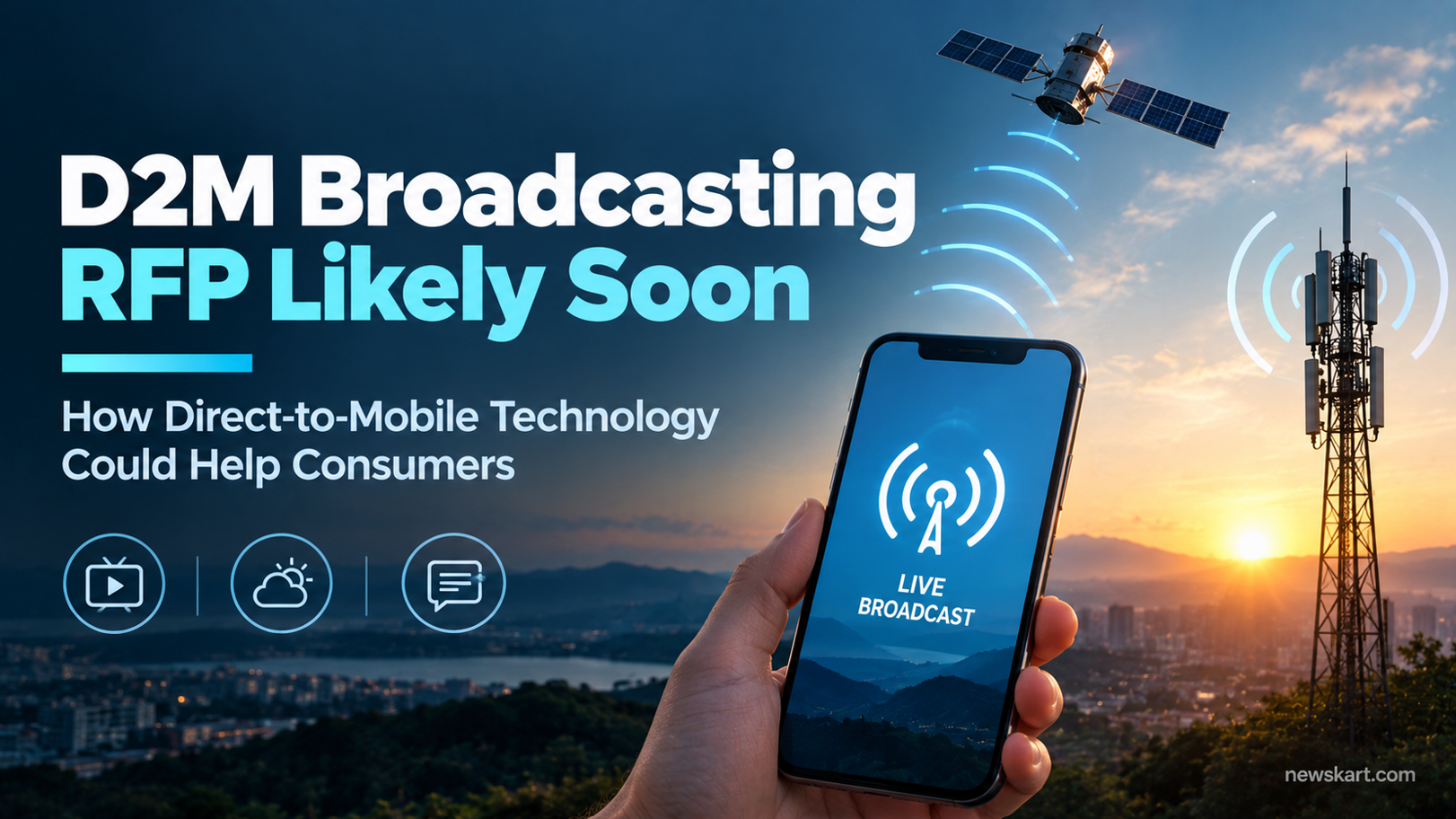
India’s Direct-to-Mobile broadcasting project may soon move closer to commercial deployment. Prasar Bharati is reportedly likely to issue a Request for Proposal within a month after recent technology validation tests.
The RFP will invite companies to participate in the next stage of the project. However, it will not mean that D2M services will launch across India immediately. The final rollout will depend on the selected partners, business model, network infrastructure and availability of compatible mobile devices as per Broadcast and CableSat.
What is D2M broadcasting
D2M stands for Direct-to-Mobile broadcasting. It is a technology that sends video, audio and data directly to compatible smartphones and other mobile devices through terrestrial broadcast networks.
The mechanism is similar to television or radio broadcasting. Instead of sending a separate internet stream to every person, a broadcaster transmits one signal that can be received by many devices in the same coverage area.
This means users may be able to watch live television, listen to radio, receive news updates or access emergency alerts without using mobile data or Wi-Fi. D2M does not depend on a SIM card for receiving the broadcast signal, but the device must contain the necessary receiver hardware and software per PIB.
How the technology could work for users
Imagine a major cricket match being watched by millions of people at the same time. With regular mobile streaming, every viewer uses a separate data connection. This creates heavy traffic on cellular networks.
With D2M, the same live broadcast can be sent through a broadcast signal to all compatible devices in the area. This could reduce pressure on mobile networks during large events.
The technology could also be useful in locations where mobile internet is slow, expensive or unreliable. Educational programmes, public information, weather warnings and disaster alerts could reach people even when data services are congested or unavailable.
For a consumer, the most visible benefit may be lower data consumption. Watching selected live content through D2M could reduce the need to use a daily data allowance for streaming.
Possible benefits for consumers
D2M could offer several practical advantages
- Live television and audio without consuming mobile data
- Better access to educational content in areas with weak internet
- Emergency alerts during floods, cyclones and other disasters
- Less network congestion during major live events
- Potentially lower-cost access to public-service content
- A wider distribution channel for broadcasters
The government has also described D2M and digital radio as tools for affordable entertainment, education and critical messaging.
What are the limitations
D2M will not work automatically on every smartphone. Compatible hardware will be necessary, so handset manufacturers may need to add suitable receivers to future devices.
Coverage is another important factor. A consumer will benefit only where D2M transmission infrastructure is available. The RFP will need to clarify who will build and operate the network and how broadcasters and private companies will participate.
The commercial model is also still developing. Questions remain around infrastructure costs, advertising, content rights, public funding and revenue sharing. Telecom operators have also raised concerns about spectrum planning and the relationship between D2M and mobile broadband.
Recent tests reportedly showed that D2M could operate alongside mobile voice calls and SMS services. Still, wider rollout will require continued testing, industry consultation and clear technical standards as per New Indian Express.
What the RFP means
An RFP is a formal request for companies to submit proposals. In this case, it could help Prasar Bharati identify technology providers, infrastructure partners and commercial participants for D2M deployment.
It is an important step, but it is not the same as a confirmed nationwide launch date. The project may still take time to move from tendering and trials to large-scale consumer access.
Conclusion with key takeaways
D2M broadcasting could bring live television, audio, education and emergency information directly to mobile devices without mobile data or Wi-Fi.
Its biggest consumer advantages may be lower data use, improved access in weak-connectivity areas and reduced network pressure during popular live events. However, compatible devices, transmission coverage and a workable commercial model will determine how useful the service becomes.
The expected RFP could provide more clarity. Until then, D2M should be viewed as a promising technology moving towards commercial evaluation, rather than an immediate replacement for mobile internet or streaming services.
Reference- Prasar Bharati D2M white paper
Discover more from Newskart
Subscribe to get the latest posts sent to your email.
