

Career Options In Artificial Intelligence And The Roadmap To Become An AI Engineer


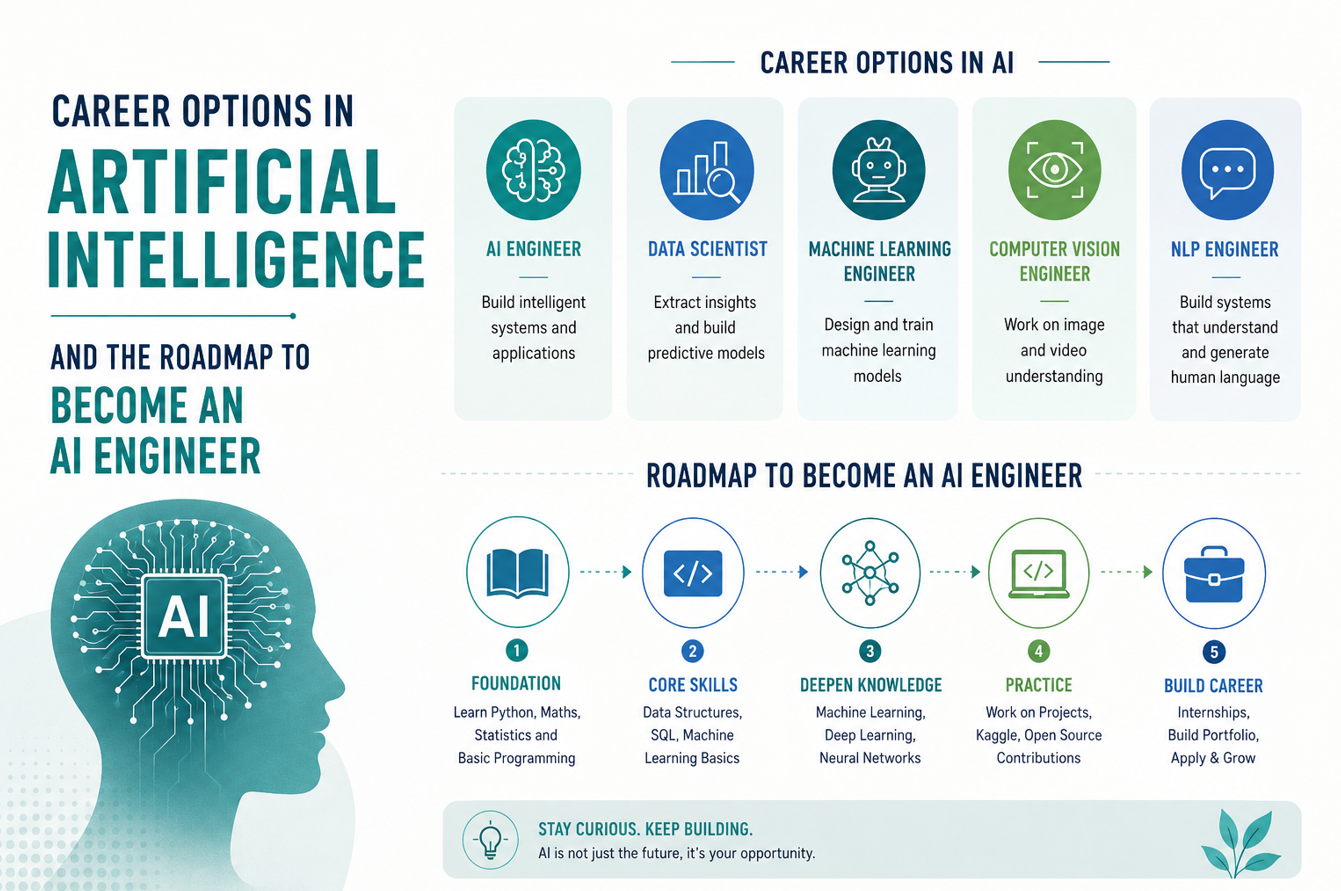
Artificial Intelligence is no longer a future topic. It is already part of banking apps, shopping recommendations, customer support, fraud detection, healthcare tools, coding assistants, cameras, chatbots and business software.
For students and working professionals, this creates a strong career opportunity. But it also creates confusion. Many people want to become an AI engineer, but they do not know where to start, what to learn, or which job role to target first.
The good news is that AI has many career paths. You do not need to become a research scientist on day one. You can start with programming, data, machine learning, software engineering or cloud, and slowly move toward advanced AI roles.
What does an AI engineer do
An AI engineer builds systems that can learn from data, make predictions, understand language, recognize images, automate tasks or support decision-making.
For example, an AI engineer may build a model that detects fake transactions for a bank. Another may create a chatbot for customer support. Someone else may build a recommendation engine for an ecommerce app or an AI tool that helps doctors analyze medical reports.
In simple words, an AI engineer turns data and algorithms into useful products.
This role is different from only using AI tools. An AI engineer understands how models work, how to train them, how to test them and how to deploy them in real applications.
Why AI careers are growing
AI skills are becoming important across industries.
The World Economic Forum’s Future of Jobs Report 2025 lists AI and big data among the fastest-growing skills. NIIT’s India Skills Gap Report 2026 also highlights AI, digital, data and cybersecurity skills as key future capabilities in India.
Indian companies are hiring AI talent for fintech, healthcare, retail, IT services, manufacturing, telecom, education, cybersecurity and SaaS products.
AI may automate some tasks, but it is also creating new roles. Companies need people who can build, manage, secure and improve AI systems.
Main career options in Artificial Intelligence
AI engineer –
This is one of the most direct roles. An AI engineer builds AI models and integrates them into real products.
They work with machine learning, deep learning, Python, APIs, cloud platforms and data pipelines. Their job is to make AI useful for business problems.
Best for – People who like coding, maths and product building.
Machine learning engineer –
A machine learning engineer focuses on models that learn from data.
They may build systems for fraud detection, customer prediction, pricing, image recognition or recommendation. They also work on model testing, accuracy and deployment.
Best for – People who enjoy programming and data-driven problem-solving.
Data scientist –
A data scientist studies data to find patterns and build predictive models.
For example, a data scientist at a telecom company may predict which customers are likely to leave. A retail data scientist may study which products sell better in which city.
Best for – People who like statistics, business questions and storytelling with data.
AI researcher –
AI researchers work on new algorithms, model architectures and advanced AI methods.
This role usually needs strong mathematics, deep learning knowledge and often a master’s or PhD. It is common in research labs, top tech companies and advanced AI startups.
Best for – People who enjoy theory, experiments and long-term research.
Generative AI engineer –
This is a newer role. Generative AI engineers build applications using large language models, image models, voice models and multimodal AI.
They work on chatbots, copilots, AI agents, summarization tools, document assistants and content automation systems.
Best for – People who like building practical AI tools using models like GPT, Claude, Gemini, Llama or other open-source models.
MLOps engineer –
MLOps means machine learning operations.
An MLOps engineer makes sure AI models run properly after deployment. They handle model monitoring, versioning, cloud infrastructure, automation and reliability.
For example, if a fraud detection model becomes less accurate over time, MLOps systems help detect the problem.
Best for – People who like cloud, DevOps and automation.
Computer vision engineer –
Computer vision engineers build AI systems that understand images and videos.
Their work is used in medical scans, self-driving systems, factory inspection, face recognition, drones, agriculture and retail analytics.
Best for – People who like image processing, cameras and visual AI.
NLP engineer –
NLP means natural language processing. NLP engineers build systems that understand text and speech.
They work on chatbots, translation, voice assistants, sentiment analysis, search tools and document understanding.
Best for – People interested in languages, text, speech and communication.
AI product manager –
An AI product manager does not always build models directly. They decide what AI product should be built, why users need it and how it should work.
They connect engineering, design, business and customers.
Best for – People who understand technology but also enjoy strategy and communication.
Skills needed to become an AI engineer
- The first skill is programming. Python is the best starting point because it is widely used in AI.
- The second skill is mathematics. You do not need to become a maths professor, but you should understand basic linear algebra, probability, statistics and calculus.
- The third skill is data handling. Learn SQL, Pandas, NumPy and data cleaning.
- The fourth skill is machine learning. Learn supervised learning, unsupervised learning, classification, regression, model evaluation and feature engineering.
- The fifth skill is deep learning. Learn neural networks, CNNs, RNNs, transformers and model training.
- The sixth skill is deployment. An AI model is useful only when people can use it. Learn APIs, Docker, cloud basics and MLOps tools.
- The seventh skill is communication. AI engineers must explain model results, limitations and risks to non-technical teams.
Beginner roadmap for AI engineer
- Start with Python. Build small projects like a calculator, file organizer or data cleaner.
- Then learn data analysis using Excel, SQL, Pandas and visualization tools.
- After that, study machine learning basics. Build projects like house price prediction, spam detection or customer churn prediction.
- Next, learn deep learning with PyTorch or TensorFlow. Try image classification or text classification projects.
- Then move to generative AI. Build a document summarizer, chatbot, resume analyzer or AI search tool.
- Finally, learn deployment. Put your project on GitHub and deploy it using FastAPI, Streamlit, Docker or a cloud platform.
Practical projects to build
- A resume screening tool for recruiters.
- A chatbot for college FAQs.
- A fraud detection model for payment data.
- A crop disease detection app using plant images.
- A customer review sentiment analyzer.
- A PDF summarizer for students.
- A recommendation system for movies or products.
- A voice-based assistant for local language users.
These projects show employers that you can solve real problems, not only complete courses.
Career path for AI engineer
The path usually starts with junior roles.
You may begin as a data analyst, Python developer, machine learning intern, AI intern or junior data scientist.
After one to three years, you can move into machine learning engineer, AI engineer, NLP engineer or computer vision engineer roles.
After five or more years, you can become senior AI engineer, MLOps lead, AI architect, data science manager or AI product leader.
With deeper research skills, you can move toward applied scientist or AI researcher roles.
Who can enter AI
Students from computer science, IT, electronics, mathematics, statistics and engineering backgrounds have a natural advantage.
But people from other fields can also enter AI if they build the right skills. Commerce students can move into business analytics. Healthcare professionals can work in health AI. Finance professionals can move into risk modelling. Language students can work in NLP and AI evaluation.
AI rewards people who combine technical skills with domain knowledge.
Common mistakes to avoid
- You should not start with only ChatGPT prompts and call yourself an AI engineer. Prompting is useful, but it is not enough.
- You should not ignore maths completely. You need at least basic understanding.
- You should not collect too many certificates without projects.
- You should not copy projects blindly from YouTube. Build something small but original.
- You should not chase every new AI tool. Focus on fundamentals first.
Conclusion with key takeaways
Artificial Intelligence offers many career options, from AI engineer and data scientist to MLOps engineer, NLP engineer, computer vision engineer and AI product manager.
For beginners, the best path is simple. Learn Python, understand data, study machine learning, build projects and then move into deep learning and generative AI. You do not need to master everything at once. You need steady learning and proof of work.
Key takeaways –
- AI engineering is one of the fastest-growing tech career paths.
- Python, data analysis, machine learning and deployment are core skills.
- Generative AI has created new roles in chatbots, AI agents and document automation.
- Projects matter more than certificates alone.
- The best AI careers combine technical skill with real-world problem understanding.
Discover more from Newskart
Subscribe to get the latest posts sent to your email.

[…] AI-assisted services are becoming popular too, but beginners should be careful. Do not sell “AI work” alone. Use AI as a helper and add your own judgment. For example, you can offer AI-assisted content research, chatbot setup, product listing improvement or workflow automation, but the final quality must come from you. […]
[…] voice-to-text means using artificial intelligence to turn spoken words into useful written […]
[…] Career Options In Artificial Intelligence And The Roadmap To Become An AI Engineer […]