

Airbound Raises $37 Million Led by Greenoaks – Why This Drone Startup Matters Beyond Funding


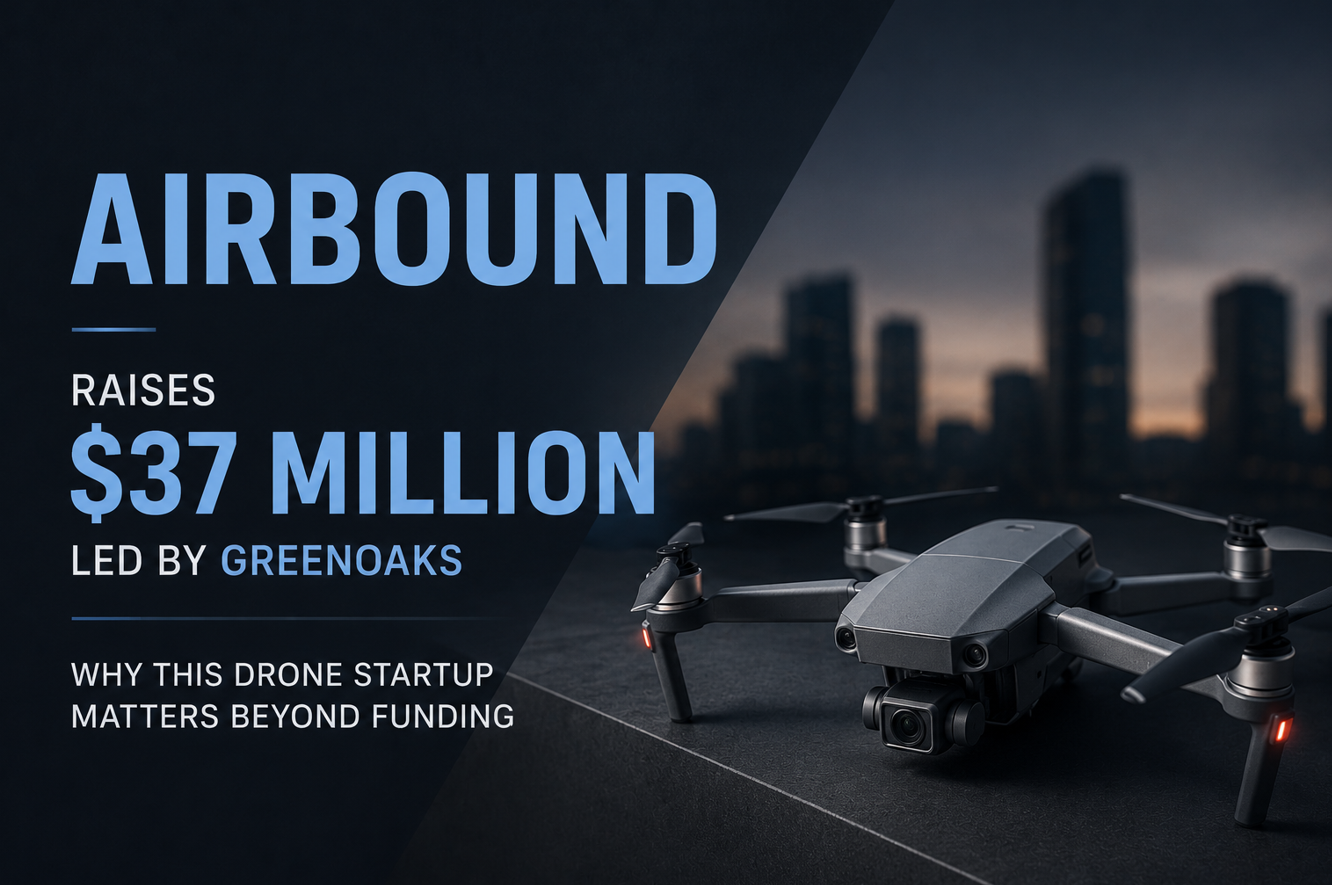
Airbound has raised $37 million in a Series A funding round led by Greenoaks, putting the Bengaluru-based drone startup in the spotlight again. The round also saw participation from DoorDash, Lachy Groom, Lightspeed and Humba Ventures.
The startup is building autonomous delivery drones that can carry small packages faster than road transport in selected use cases. This is not just another startup funding story. It is also a sign that investors are taking Indian deep-tech, aerospace and logistics innovation more seriously.
Airbound was founded in 2023 by Naman Pushp, who started working on drones as a teenager. With this new funding, the company’s total capital raised has reached nearly $50 million.
What Airbound does
Airbound is developing lightweight autonomous aircraft for delivery. These drones are designed to take off and land vertically, which means they do not need a runway.
The company’s current drone is called TRT. According to TechCrunch, it weighs about 3.3 pounds and can carry around 2.2 pounds of payload. Airbound is also working on a larger version that may carry up to 11 pounds.
In simple words, Airbound wants to move small but urgent items through the air. This can include diagnostic samples, medicines, ecommerce parcels, food items or other time-sensitive packages.
Purpose of the $37 million funding
The fresh funding will be used to expand engineering, manufacturing and commercial operations.
This is important because drone delivery is not only about building one working prototype. A startup needs to manufacture drones at scale, test them safely, improve reliability, get regulatory approvals and convince real businesses to use them.
Airbound already designs and manufactures its aircraft at a 43,000-square-foot facility in Bengaluru, according to report. The new funding can help the company move from trials and limited routes to larger commercial networks.
Why healthcare is a strong use case
One of Airbound’s most practical early use cases is healthcare logistics.
The company has worked with Narayana Health to transport diagnostic samples between healthcare facilities. As per report, Airbound has completed more than 1,000 flights with the hospital network.
This is where drones can make real sense. A blood sample or diagnostic sample may not be heavy, but it can be urgent. If a road trip takes hours because of traffic or batching delays, a drone route can save valuable time.
For patients, faster sample movement can mean quicker test results. For hospitals, it can reduce dependence on road-based pickup systems for small medical items.
Different point of view – Why investors may like Airbound
From an investor’s point of view, Airbound is not only a delivery company. It is a deep-tech hardware company building its own aircraft design.
That matters because proprietary technology can create a stronger business moat if it works well. Airbound is trying to make drone delivery cost-competitive with road transport, which is a difficult but large opportunity.
DoorDash’s participation is also interesting. As a delivery platform, DoorDash understands last-mile logistics. Its investment suggests that global delivery companies are watching drone delivery closely, even if large-scale adoption may take time.
Different point of view – What businesses may see
For businesses, the question is simple – can drone delivery reduce time or cost?
In healthcare, the answer may be clearer because speed matters. In ecommerce or quick commerce, the answer depends on payload size, route, regulation and cost.
A drone may not replace trucks or bikes everywhere. But it can be useful for short, repeated routes where small items need to move quickly. For example, a hospital network, a lab chain or a high-density delivery corridor may benefit more than a random long-distance route.
Different point of view – What could slow Airbound down
The biggest challenge is regulation.
Drone delivery at scale needs approvals for beyond visual line of sight operations. This means drones can fly beyond the direct view of a human operator. Without such approvals, large delivery networks become difficult.
There are also practical questions. How will drones handle bad weather? How will they land safely in crowded areas? Can they operate cheaply enough every day? Will customers and regulators trust them?
These are not small problems, but they are normal for a serious deep-tech startup.
Competitors and market overview
Airbound competes in a growing drone logistics space. In India, companies such as Skye Air Mobility, TSAW Drones and Garuda Aerospace have worked on drone delivery or related drone services.
Globally, companies like Zipline, Wing and Amazon Prime Air have also explored drone delivery. Airbound’s difference appears to be its focus on ultra-light aircraft design and cost efficiency.
Discover more from Newskart
Subscribe to get the latest posts sent to your email.

Comments are closed.