

Aheesa’s VIHAAN Chip Gets First-Pass Silicon Success, A Big Win for India’s Broadband Tech Push


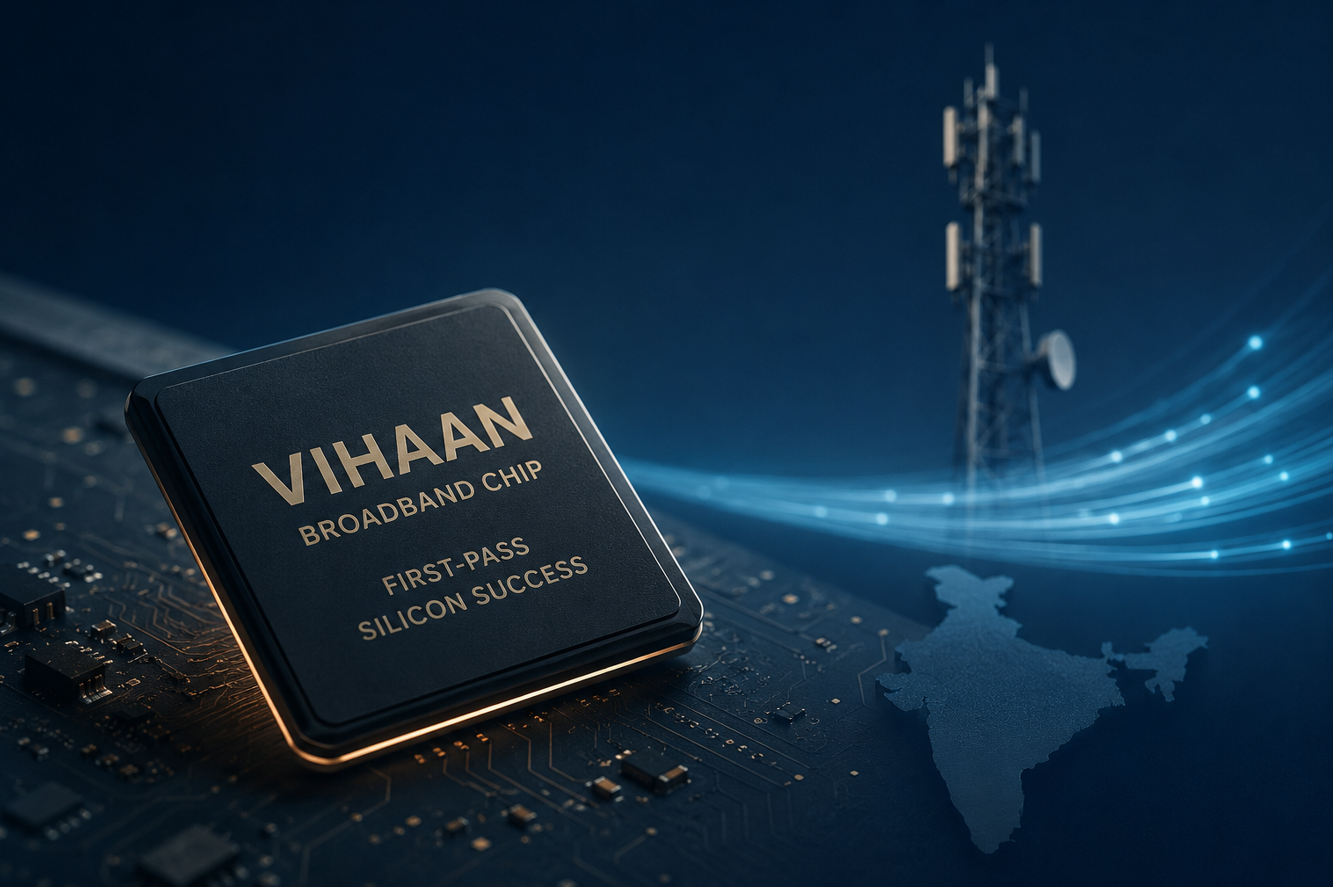
India’s semiconductor journey has got another important boost. Chennai-based fabless semiconductor startup Aheesa Digital Innovations has achieved first-pass silicon success with its indigenous broadband chip, VIHAAN.
This is not just another startup update. In the chip world, first-pass silicon success means the first manufactured version of the chip works as expected. That is a serious milestone because chip design is expensive, complex and difficult to correct once the design goes into fabrication.
VIHAAN is built for fiber broadband networks. In simple terms, it is designed for devices that help bring high-speed internet to homes, offices and businesses. At a time when India wants to reduce dependence on imported telecom hardware, this development has both business and national importance.
What Aheesa Digital Innovations does
Aheesa Digital Innovations is a Chennai-based fabless semiconductor company founded in 2021. Its founders are Sukha Ranjan Ghosh, Anil Raj Thulasidas and Sridharan Mani.
The company works on ASIC design, networking chips, embedded systems and communication technologies. Being fabless means Aheesa designs the chip but does not own a semiconductor factory. This is a common model followed by many global chip companies. The design is done by the startup, while actual manufacturing is handled by a foundry.
Aheesa’s main focus is indigenous chip design for telecom, networking and broadband use cases. That makes it different from many software-first startups because it is building deep hardware technology.
What is VIHAAN
VIHAAN is Aheesa’s indigenous broadband networking System-on-Chip, also called SoC. An SoC is a chip that combines many important functions into one piece of silicon.
In VIHAAN’s case, the chip is built for fiber broadband equipment such as GPON and EPON Optical Network Terminal devices. These are commonly used in fiber internet networks.
A simple example will help. When a fiber broadband cable comes into a home or office, it usually connects to a small box before internet reaches your Wi-Fi router or computer. That box needs a chip to manage the fiber signal, data processing and network control. VIHAAN is designed for this kind of broadband access equipment.
The chip is based on RISC-V, an open processor architecture. It uses India’s indigenous VEGA processor technology developed by C-DAC. This matters because RISC-V allows more design freedom and can reduce dependence on closed foreign processor technologies.
Why first-pass silicon success is important
Chip design is not like building a normal app where bugs can be fixed with a quick update. Once a chip design is sent for manufacturing, the process takes time and money. If the first manufactured chip does not work properly, the company may need to redesign it and send it again for another fabrication cycle.
That can delay a product by several months and increase costs sharply.
First-pass silicon success means the chip worked in the first attempt after fabrication. For a startup, this shows strong design, verification and engineering discipline. It also gives confidence to investors, customers and government agencies that the technology is moving in the right direction.
For India, it is a sign that local chip design companies are now capable of handling complex silicon projects, not just basic electronics assembly.
How DLI and MeitY supported this journey
Aheesa’s VIHAAN project is backed under the Design Linked Incentive scheme of the Ministry of Electronics and Information Technology, or MeitY.
The DLI scheme was launched under the Semicon India Programme to support domestic semiconductor design companies. It provides financial support, access to chip design tools, IP cores, prototyping support and post-silicon validation help.
According to PIB, the DLI scheme supports chip design projects across areas such as broadband, IoT, energy meters, microprocessors, satellite communication, drone detection and video surveillance. The scheme has helped Indian startups move from ideas to actual chip tape-outs and fabricated silicon.
This support is important because chip design tools and prototype manufacturing are expensive. For a young startup, access to such infrastructure can reduce risk and make serious hardware innovation possible.
Why VIHAAN matters for India’s broadband market
India is adding more fiber broadband users every year. Homes, small shops, startups, schools, hospitals and offices all need stable internet. Behind every fiber connection is a chain of telecom equipment, and much of that equipment depends on imported chips.
VIHAAN aims to reduce that dependence in one focused area – broadband access silicon.
If the chip reaches commercial deployment, Indian telecom equipment makers and OEMs may get a domestic option for fiber broadband devices. This can help lower supply chain risk, improve local value addition and support India’s Make in India and Aatmanirbhar Bharat goals.
It can also become useful for 5G edge, IoT and secure networking applications, depending on how Aheesa builds the wider product platform around the chip.
What makes VIHAAN technically interesting –
VIHAAN is designed around a RISC-V based architecture and targets broadband access networks. It integrates compute, fiber termination, data processing and network management functions into a single chip.
Aheesa’s website also mentions support around the VIHAAN platform, including its Seshnag reference platform and Aheesa Router OS, which is based on OpenWRT. This is useful because customers do not buy only a chip. They usually need boards, drivers, software and development support to build a finished product.
That full-stack approach can help OEMs and ODMs reduce product development time. Instead of starting from zero, they can use Aheesa’s reference design and software base to build broadband devices faster.
Competitors and market challenge
Aheesa is entering a tough global market. Broadband and PON chipset segments already have strong players such as Broadcom, MediaTek and Realtek. These companies have years of experience, large customer bases and mature software ecosystems.
Broadcom, for example, has a wide xPON product portfolio for residential and telecom infrastructure equipment. Competing with such companies will not be easy.
Aheesa’s advantage is its India-first positioning, RISC-V base and DLI-supported indigenous design. But to win customers, it will still need reliable performance, competitive pricing, strong software support, security features and long-term supply assurance.
Telecom equipment companies do not change chip platforms casually. They need confidence that the product will work in the field for years.
What happens next
First-pass silicon success is a major step, but it is not the final destination. The next stage will include testing, validation, reference platform development, customer trials and preparation for commercial production.
PIB has earlier noted that Aheesa is on track to introduce reference platforms for customer exploration in 2026. Other reports have also pointed to commercial market plans around 2027.
If Aheesa executes well, VIHAAN could become one of India’s most important homegrown broadband chip stories. It may also encourage more Indian startups to work on real silicon products instead of stopping at design services.
Conclusion with key takeaways
Aheesa Digital Innovations’ VIHAAN chip is a meaningful development for India’s semiconductor ecosystem. It shows that local startups can design complex chips for real infrastructure needs like fiber broadband.
Key takeaways –
- Aheesa Digital Innovations was founded in 2021 by Sukha Ranjan Ghosh, Anil Raj Thulasidas and Sridharan Mani.
- VIHAAN is an indigenous RISC-V based broadband networking SoC for fiber broadband equipment.
- The chip has achieved first-pass silicon success, which means the first manufactured version worked as intended.
- The project is backed by MeitY’s Design Linked Incentive scheme under the Semicon India Programme.
- VIHAAN can help reduce India’s dependence on imported broadband access chips if it reaches commercial scale.
- Aheesa will compete with global chipset players such as Broadcom, MediaTek and Realtek.
Facts Input- Lokmattimes, PIB
Discover more from Newskart
Subscribe to get the latest posts sent to your email.

Comments are closed.