

BSNL Brings 4G to Teressa Island Through DweepSetu, A 46.8 Km Wireless Bridge Across the Sea


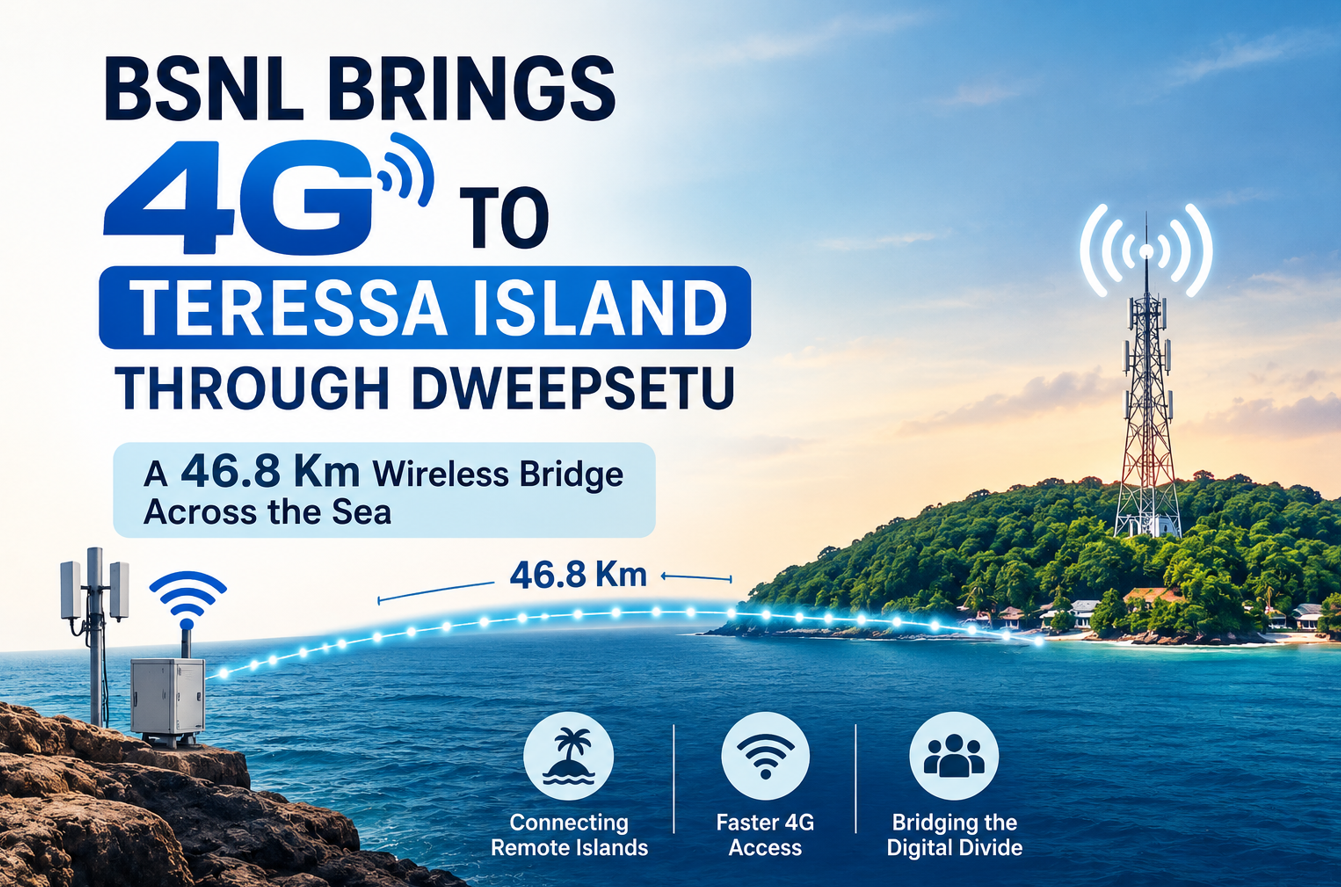
BSNL has brought high-speed 4G connectivity to Teressa Island in the Andaman and Nicobar Islands through a project called DweepSetu. The biggest highlight is the 46.8 km wireless radio link that connects Teressa with Kamorta, without waiting for an undersea fibre cable to reach the island.
For people in cities, 4G is routine. But for a remote island, it can change daily life. It can help students attend online classes, families make video calls, shops accept digital payments, and local officials send urgent information faster.
Teressa has long faced poor connectivity because it is far from major telecom infrastructure. The island is not currently connected through submarine Optical Fibre Cable, so earlier telecom services mainly depended on a limited satellite link. DweepSetu works like a digital bridge until fibre reaches the island.
What is DweepSetu
DweepSetu means an island bridge. In this case, it is a high-speed wireless radio link between Kamorta and Teressa.
According to Nicobar Times, the link covers 46.8 km and has enabled BSNL to deliver 4G services at two sites on Teressa Island. BSNL officials also said two more sites on the island will be connected through the same radio link.
This is important because laying submarine fibre cable is expensive, slow and full of approvals. A radio link can be deployed faster if there is clear line-of-sight, proper equipment, stable power and strong planning.
How this became possible
The project became possible through coordination between the Department of Telecommunications, BSNL and Telecommunications Consultants India Ltd. BSNL used a long-distance wireless link from Kamorta to Teressa instead of waiting for undersea cable work.
Earlier, Teressa depended mainly on a 10 Mbps satellite link. Satellite connectivity is useful in remote areas, but it has limits. It can be slower, costlier and more affected by capacity issues. A dedicated high-speed radio link can offer better support for 4G mobile services.
In simple terms, BSNL created a wireless backhaul route. Backhaul is the connection that carries data from a mobile tower to the wider internet. Without good backhaul, a tower may show 4G signal, but users will still face slow speeds.
Why Teressa was difficult to connect
- The first challenge was distance. Teressa is around 48 km from Kamorta and about 82 km from Car Nicobar, the Nicobar district headquarters. Moving telecom equipment, tools and technical teams to such locations is not easy.
- The second challenge was the absence of submarine OFC. Fibre is usually the best option for high-speed telecom, but Teressa is still waiting for it. Until that happens, BSNL had to find another way to carry enough data for 4G.
- The third challenge was weather and terrain. Island telecom work depends on sea conditions, transport schedules, tower location, wind, rain and power availability. Even a small technical fault can take longer to fix because spare parts and engineers may not be nearby.
- The fourth challenge was maintenance. Remote islands need reliable support after launch. A network is useful only if it keeps working during normal days, bad weather and emergencies.
Why this matters for people on Teressa Island
The benefit is very practical. A student can download notes or join a live class. A patient can speak to a doctor over video. A shopkeeper can accept UPI payments more smoothly. Families can stay in touch with relatives outside the island.
Government services can also improve. Better mobile internet helps in digital certificates, welfare schemes, emergency alerts, online forms and coordination between local offices.
For an island community, connectivity is not just entertainment. It is access to education, healthcare, banking, safety and opportunity.
Competitor and telecom angle
In remote island areas, BSNL often plays a larger role because private operators may not rush to invest where population is small and costs are high. The Phoenix Post report also highlights BSNL’s wider push to improve connectivity across Andaman and Nicobar Islands.
Private telecom players such as Airtel and Jio are active in better-connected parts of the islands, but remote locations need government-backed projects and public-sector execution. That is where BSNL’s 4G rollout becomes important.
What comes next
DweepSetu is a strong step, but the long-term solution will still be stronger fibre connectivity. Submarine OFC for islands like Teressa, Chowra, Katchal and Little Nicobar has been discussed, but implementation takes time.
Until then, the 46.8 km radio link gives Teressa a much-needed bridge to faster internet. The next test will be service quality, uptime and expansion to more sites on the island.
Conclusion with key takeaways
BSNL’s 4G launch on Teressa Island through DweepSetu is a meaningful digital inclusion story. It shows how telecom teams can use wireless radio links to solve difficult connectivity problems in remote islands.
Key takeaways –
- BSNL has brought 4G to Teressa Island through DweepSetu.
- DweepSetu is a 46.8 km high-speed wireless radio link between Kamorta and Teressa.
- The island was earlier dependent mainly on a 10 Mbps satellite link.
- Teressa is still not connected through submarine OFC.
- The project can help residents with education, healthcare, digital payments and emergency communication.
Facts Input- Nicobar Times, The Phoenix Post, DWIEP, PIB
Discover more from Newskart
Subscribe to get the latest posts sent to your email.

Comments are closed.